For the basic understanding on Transmission Mode, please refer to my previous post on Transmission Mode (for Release 8). I would highlight the new TM introduced in Release 10. The two tables reproduced below were captured at Release 10, so the downlink one ends at Mode 9 and the uplink one at Mode 2. The last section on this page says what 36.213 v19.4.0 carries instead.
- Downlink Transmission Mode
- Uplink Transmission Mode
- Transmission Mode 9
- What the current release adds to these tables
- Reference
Downlink Transmission Mode
You would see new TMs every time you get additional antenna ports being used and they bring some new idea of using those antenna ports. But as far as I see from the several carrier network configuration as of now (Aug 2013), I only see TM3 being used in the field. (Please let me know if you see other TMs being used in the field).
The table below is the one that ties a transmission mode to the DCI format that schedules it. Each mode has two rows: a fallback row on DCI format 1A, and a row for the format the mode actually uses. The brackets down the right hand side are the author's, and they mark which modes each release added.
< 36.213 Table 7.1-5 : PDCCH and PDSCH configured by C-RNTI >
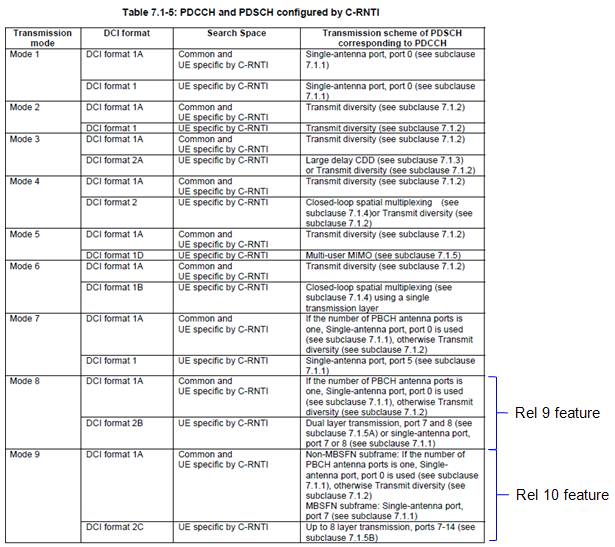
You can find good introductions on TM9 in the following link :
- 3G and 4G Wireless Blog : LTE-A: Downlink Transmission Mode 9 (TM-9)
- SK Telecom and Ericsson Demonstrate LTE-A TM-9 Technology
Transmission Mode and Reference Signal
One of the confusing but important thing about transmission mode is to understand the relationship between each transmissiom mode and reference signal (antenna ports). For this, refer to Reference Signal (Antenna Port Number) vs Transmission Mode in Reference Signal (Downlink) page.
Uplink Transmission Mode
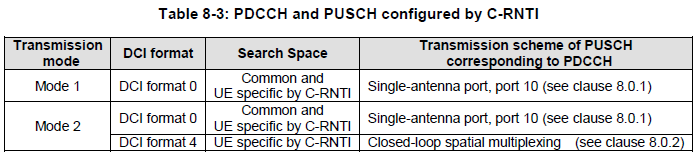
The uplink side of the same idea is far smaller. Only two uplink transmission modes were ever defined, because the uplink gained spatial multiplexing once and the specification never added a third mode. The table below is the uplink counterpart of the downlink one above.
The columns are the same four as the downlink table, and the last one names the PUSCH transmission scheme rather than the PDSCH one.
< 36.213 Table 8-3 : PDCCH and PUSCH configured by C-RNTI >
Transmission Mode 9
For Beam Forming aspect of TM9, refer to Beam Forming in LTE section. What follows is the DCI format that carries TM9 scheduling. The first two tables give the field list of format 2C, once for a normal subframe and once with the carrier indicator present, and the two after them work a real hex string through that field list.
The field list below is DCI format 2C as it is sent to a UE configured with C-RNTI or SPS C-RNTI. Read the length column first, because several of the fields are sized by the bandwidth and by the mode rather than fixed.
|
Field Name |
Length (Bits) |
Comment |
|
Resource allocation header |
1 |
RA Type 0 or RA Type 1 |
|
Resource block assignment for RA Type 0 |
6 (1.4 Mhz) 8 (3 Mhz) 13 (5 Mhz) 17 (10 Mhz) 19 (15 Mhz) 25 (20 Mhz) |
Applicable only when Resource allocation header = 0 (RA Type 0) Refer to RA Type page |
Subset |
N/A (1.4 Mhz) 1 (3 Mhz) 1 (5 Mhz) 2 (10 Mhz) 2 (15 Mhz) 2 (20 Mhz) |
Applicable only when Resource allocation header = 1 (RA Type 1) Refer to RA Type page |
Shift |
N/A (1.4 Mhz) 1 (3 Mhz) 1 (5 Mhz) 1 (10 Mhz) 1 (15 Mhz) 1 (20 Mhz) |
Applicable only when Resource allocation header = 1 (RA Type 1) Refer to RA Type page |
|
Resource block assignment for RA Type 1 |
N/A (1.4 Mhz) 6 (3 Mhz) 13 (5 Mhz) 14 (10 Mhz) 16 (15 Mhz) 22 (20 Mhz) |
Applicable only when Resource allocation header = 1 (RA Type 1) Refer to RA Type page |
|
TPC for PUCCH |
2 |
See Power Control section |
|
Downlink Assignment Index |
2 |
Only Applicable to TDD uplink –downlink configuration 1-6. |
|
HARQ Process |
3 (FDD) 4 (TDD) |
|
Ports-SCID-Number of Layers |
3 (FDD) |
|
|
MCS for Transport Block 1 |
5 |
|
|
NDI for Transport Block 1 |
1 |
|
|
RV for Transport Block 1 |
2 |
|
|
MCS for Transport Block 2 |
5 |
|
|
NDI for Transport Block 2 |
1 |
|
|
RV for Transport Block 2 |
2 |
|
The list below is the same format with the carrier indicator field present. Cross carrier scheduling adds those three bits at the front, and nothing else in the format moves.
|
Field Name |
Length (Bits) |
Comment |
|
Carrier Indicator |
3 |
|
|
Resource allocation header |
1 |
RA Type 0 or RA Type 1 |
|
Resource block assignment for RA Type 0 |
6 (1.4 Mhz) 8 (3 Mhz) 13 (5 Mhz) 17 (10 Mhz) 19 (15 Mhz) 25 (20 Mhz) |
Applicable only when Resource allocation header = 0 (RA Type 0) Refer to RA Type page |
Subset |
N/A (1.4 Mhz) 1 (3 Mhz) 1 (5 Mhz) 2 (10 Mhz) 2 (15 Mhz) 2 (20 Mhz) |
Applicable only when Resource allocation header = 1 (RA Type 1) Refer to RA Type page |
Shift |
N/A (1.4 Mhz) 1 (3 Mhz) 1 (5 Mhz) 1 (10 Mhz) 1 (15 Mhz) 1 (20 Mhz) |
Applicable only when Resource allocation header = 1 (RA Type 1) Refer to RA Type page |
|
Resource block assignment for RA Type 1 |
N/A (1.4 Mhz) 6 (3 Mhz) 13 (5 Mhz) 14 (10 Mhz) 16 (15 Mhz) 22 (20 Mhz) |
Applicable only when Resource allocation header = 1 (RA Type 1) Refer to RA Type page |
|
TPC for PUCCH |
2 |
See Power Control section |
|
Downlink Assignment Index |
2 |
Only Applicable to TDD uplink –downlink configuration 1-6. |
|
HARQ Process |
3 (FDD) 4 (TDD) |
|
Ports-SCID-Number of Layers |
3 (FDD) |
|
|
MCS for Transport Block 1 |
5 |
|
|
NDI for Transport Block 1 |
1 |
|
|
RV for Transport Block 1 |
2 |
|
|
MCS for Transport Block 2 |
5 |
|
|
NDI for Transport Block 2 |
1 |
|
|
RV for Transport Block 2 |
2 |
|
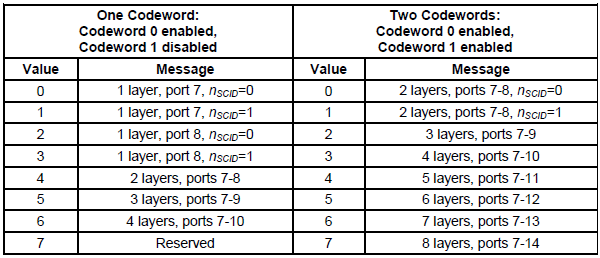
One field in that list needs a table of its own. The antenna port, scrambling identity and layer count travel as a single three bit index, and the picture below is what the index means at each of its eight values.
< 36.212 Table 5.3.3.1.5C-1: Antenna port(s), scrambling identity and number of layers indication >
The table below takes one real format 2C payload field by field. The hex string in its header row is the whole DCI, and each row shows the bits that field took and what those bits meant.
|
Example 1 : FDD - Format 2C (Release 10) - C-RNTI, SPS C-RNTI - Normal = 7E0000102F2F00 |
||
|
Field Name |
Value (Binary) |
Meaning |
|
Resource allocation header |
0 |
RA Type 0 |
|
Resource block assignment for RA Type 0 |
1111110000000000000000000 |
24 RBs |
|
TPC for PUCCH |
01 |
|
|
HARQ Process |
000 |
|
Ports-SCID-Number of Layers |
000 |
|
|
MCS for Transport Block 1 |
10111(23 Dec) |
|
|
NDI for Transport Block 1 |
1 |
|
|
RV for Transport Block 1 |
00 |
|
|
MCS for Transport Block 2 |
10111(23 Dec) |
|
|
NDI for Transport Block 2 |
1 |
|
|
RV for Transport Block 2 |
00 |
|
The second worked example uses the same field list and a different payload. Comparing the two row by row shows which fields a scheduler moves from one subframe to the next.
|
Example 2 : FDD - Format 2C (Release 10) - C-RNTI, SPS C-RNTI - Normal = 7E0000102F0140 |
||
|
Field Name |
Value (Binary) |
Meaning |
|
Resource allocation header |
0 |
RA Type 0 |
|
Resource block assignment for RA Type 0 |
1111110000000000000000000 |
24 RBs |
|
TPC for PUCCH |
01 |
|
|
HARQ Process |
000 |
|
Ports-SCID-Number of Layers |
000 |
|
|
MCS for Transport Block 1 |
10111(23 Dec) |
|
|
NDI for Transport Block 1 |
1 |
|
|
RV for Transport Block 1 |
00 |
|
|
MCS for Transport Block 2 |
00000(0 Dec) |
|
|
NDI for Transport Block 2 |
1 |
|
|
RV for Transport Block 2 |
01 |
|
What the current release adds to these tables
Both pictures above are screenshots, and both are behind the specification they came from. 36.213 has reached v19.4.0 and it now carries a mode the downlink table does not show, a family of DCI formats neither table shows, and three sibling tables for the control channels that were added after PDCCH.
Reference
Two specifications carry the tables on this page. Both were resolved at their latest published version at the time of writing.
- 3GPP TS 36.213 v19.4.0, E-UTRA Physical layer procedures. Table 7.1-5 for the downlink transmission modes and Table 8-3 for the uplink ones.
- 3GPP TS 36.212 v19.3.0, E-UTRA Multiplexing and channel coding. Clause 5.3.3.1.5C for DCI format 2C and Table 5.3.3.1.5C-1 for the antenna port indication.