This is a kind of subelements specifying how "Radio Information" relevant to the device's location capabilities should be formatted and what kind of data it contains. This can be used in various applications, including indoor location tracking, network diagnostics, and location-based services etc
This page explains the fields one by one and then shows how the two signal fields, RCPI and RSNI, turn into numbers you can use. The subelement is only seven octets long, but it carries everything a location engine needs to relate a report to a signal level.
What is in the Radio Information subelement ?
Every field in this subelement is a single octet, so the layout is simple. The diagram below shows the fields in order. Under them is the list of location subelements that the Radio Information subelement belongs to, with its own row highlighted.
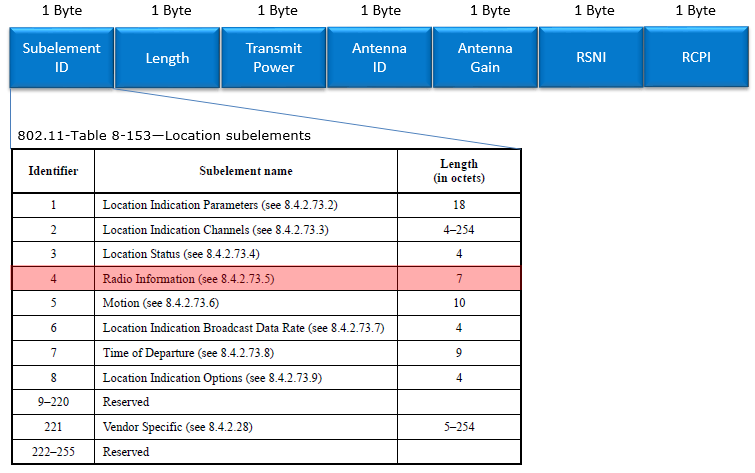
This is a description of each elements :
Subelement ID : A 1-byte field that uniquely identifies the subelement type, in this case, "Radio Information."Length : A 1-byte field that specifies the length of the subelement data in bytes.Transmit Power : A 1-byte field that indicates the transmit power at which the reporting device is operating.Antenna ID : A 1-byte field that specifies the identifier of the antenna used for transmission.Antenna Gain : A 1-byte field that represents the gain of the antenna in dBi.RSNI : A 1-byte field that stands for Received Signal to Noise Indicator, a measure of signal quality.RCPI : A 1-byte field that stands for Received Channel Power Indicator, a measure of the received signal strength.
The table under the diagram is 802.11 Table 8-153, Location subelements. Radio Information has the identifier 4 and a length of 7 octets. That matches the seven 1-byte fields in the diagram, if the count includes the Subelement ID and Length fields. The same table holds the other location subelements, from Location Indication Parameters with identifier 1 to Location Indication Options with identifier 8, and Vendor Specific at 221. So Radio Information is one of several blocks that a device can include when it takes part in location reporting.
Radio Information is subelement 4 : a parser finds it by the identifier 4 in the first octet, among the other location subelements.The whole subelement fits in 7 octets : each of the seven fields in the diagram is 1 byte.Two fields describe the transmitter and two describe the received signal : Transmit Power and Antenna Gain describe the sending side, and RSNI and RCPI describe what was received.
How do you read the signal fields ?
A raw octet is not a signal level, so let's see how the numbers convert. RCPI is coded in 0.5 dB steps starting at -110 dBm. The value in dBm is RCPI / 2 - 110. So an RCPI of 0 means -110 dBm or less, an RCPI of 100 means -60 dBm, and an RCPI of 220 means 0 dBm or more. RSNI describes signal quality rather than power. It is a measure of the signal to noise plus interference ratio, and its exact encoding is not covered on this page.
Transmit Power and Antenna Gain become useful when you combine them with a received power. Take a device that transmits at 15 dBm through a 2 dBi antenna. It radiates about 15 + 2 = 17 dBm. If the other side measures -60 dBm, the path loss is about 17 - (-60) = 77 dB, not counting the receive antenna gain. In free space at 2.437 GHz, 77 dB of path loss corresponds to about 69 m. Indoors, walls and bodies add loss, so the same 77 dB means a shorter distance. This is the basic idea behind location from signal strength, and it is also why these estimates carry a large error.
RCPI converts to dBm directly : dBm = RCPI / 2 - 110, in 0.5 dB steps.Path loss needs both sides of the link : Transmit Power and Antenna Gain give the radiated power, and RCPI gives the received power.Signal strength gives a rough distance only : the same path loss means a different distance in free space and indoors.