As far as I recall, MU-MIMO was first introduced for Downlink only in 802.11ac and evolved to support both downlink and uplink in 802.11ax. 802.11ac allows downlink MU-MIMO to up to 4 STAs at the same time, with at most 8 spatial streams in total. Let's first see what MU-MIMO is. Then we walk through the frame exchange when only the downlink is multi-user, and again when both directions are. The last section covers channel sounding, which every MU-MIMO transmission depends on.
- What is MU-MIMO ?
- MU-MIMO Process for Downlink only
- MU-MIMO Process for Downlink and Uplink
- How does the AP learn the channel for MU-MIMO ?
- References :
- YouTube
What is MU-MIMO ?
MU-MIMO (Multi User MIMO) is a type of MIMO technique that enable the transmitter to send signals to multiple users at the same time (simultaneously). We have two keywords here. Multiple User and Simultaneous are the keywords.
The basic principle of this technology is to do a specific type of beamforming that are directing to multiple directions.
MU-MIMO is often illustrated as follows. As you see, a special antenna radiation pattern is used. The radiation pattern form a specific pattern which forms multiple boresight (main direction).
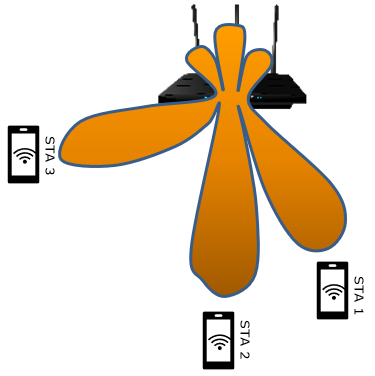
- The AP antennas sit at the top, and one radiation pattern has several main lobes.
- Each main lobe points at one station: STA 1, STA 2 and STA 3.
- Between the lobes the pattern is weak, so the signal for one STA reaches the other STAs only at a low level.
The illustration above shows only the spatial aspect of MU-MIMO and does not indicated anything about temporal aspect. So I would like to represent MU-MIMO as follows to show both spatial and temporal aspect of the operation.
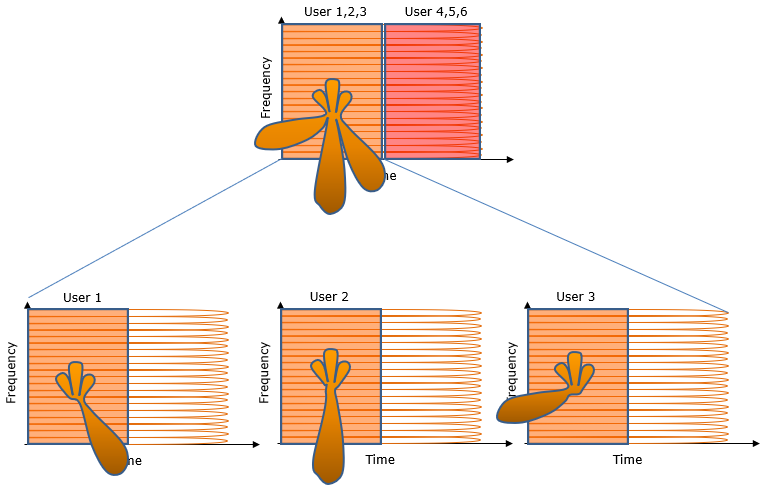
Top panel : Users 1, 2 and 3 share one time slot over the whole frequency range, with three beams. Users 4, 5 and 6 share the next time slot.Lower panels : User 1, User 2 and User 3 each get the full frequency band for the same time. Only the beam direction differs.
So MU-MIMO separates the users in space, while the time and the frequency stay shared. The AP needs a precoder that points one stream at each STA and keeps it away from the others. Zero forcing, for example, inverts the channel matrix, and this works only when the channel matrix is invertible. So an AP with N antennas can serve at most N spatial streams in total. The channels of the grouped STAs must also be different enough from each other.
MU-MIMO shares time and frequency : the users are separated by beams, not by time slots or subcarriers.The antennas set the limit : 802.11ac allows up to 4 STAs and 8 spatial streams in total.Grouping matters : the AP picks STAs whose channels differ, and 802.11ac carries a Group ID field in the PHY preamble to support this grouping.
MU-MIMO Process for Downlink only
Let's assume a case where MU-MIMO is supported only for downlink and is not supported for Uplink. In this case, DL packet can be transmitted simultaneously as shown in the first diagram, but ACK/NACK from each STA cannot be received simultaneously.
The two diagrams below split the exchange into a protection part and an acknowledgement part. In the diagram right below, the AP sends MU-RTS, labelled Trigger#1, after AIFS. STA1, STA2 and STA3 answer with CTS one after another, with SIFS between them. Then the AP sends DL PPDU : STA1, STA2 and STA3 at the same time, stacked in one block.
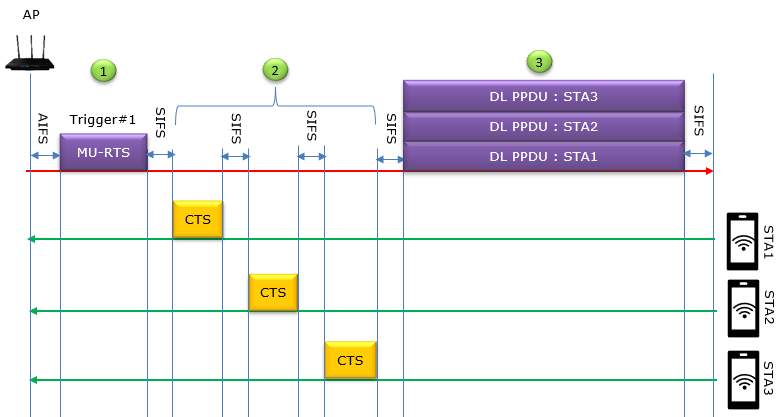
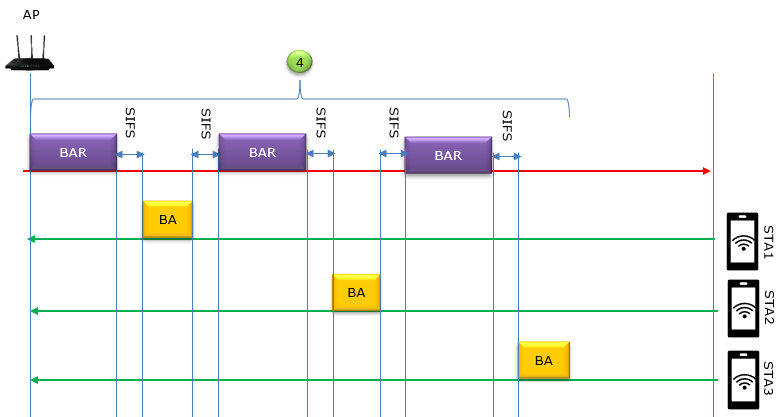
- Step (1) : the AP sends MU-RTS after AIFS.
- Step (2) : STA1, STA2 and STA3 send CTS one after another, with SIFS gaps.
- Step (3) : the AP sends the DL PPDUs for the three STAs at the same time. This is the only multi-user step.
- Step (4) : in the diagram above, the AP sends a BAR to each STA in turn, and each STA answers with a BA after SIFS.
So the downlink data takes one PPDU time, but the acknowledgements take one BAR and BA exchange per STA. The overhead therefore grows with the number of STAs, while the data time does not. This is the reason for the uplink multi-user support in the next section.
The label MU-RTS needs one remark. MU-RTS is a Trigger frame of 802.11ax, with Trigger Type 3, and it addresses each STA by its AID in a User Info field. In 802.11ax, every addressed STA answers with an identical CTS, SIFS after the MU-RTS, and all of them send it at the same time. So the CTS sequence in step (2) illustrates the assumed downlink-only case, where the STAs cannot transmit at the same time.
Only the data is multi-user here : CTS, BAR and BA all run one STA at a time.The acknowledgement cost grows with the group : three STAs need three BAR and BA pairs.
MU-MIMO Process for Downlink and Uplink
The overall protocol sequence for DL+UL MU-MIMO is very similar to OFDMA DL protocol sequence. The main difference between MU-MIMO and OFDAM protocol would be at step (3). In MU-MIMO, DL-PPDU for every user occupies the same spectrum and is just transmitted through different beam, but in OFDMA each of DL-PPDU is transmitted different RF spectrum (NOTE : this difference that I mentioned is based on the assumption is that the system support OFDMA only or MU-MIMO only, not both acting at the same time).
The diagram below has the same five steps, but steps (2), (4) and (5) change. All three STAs send CTS at the same time in step (2). The AP sends one BAR for all STAs in step (4), and all three STAs send Block ACK at the same time in step (5).
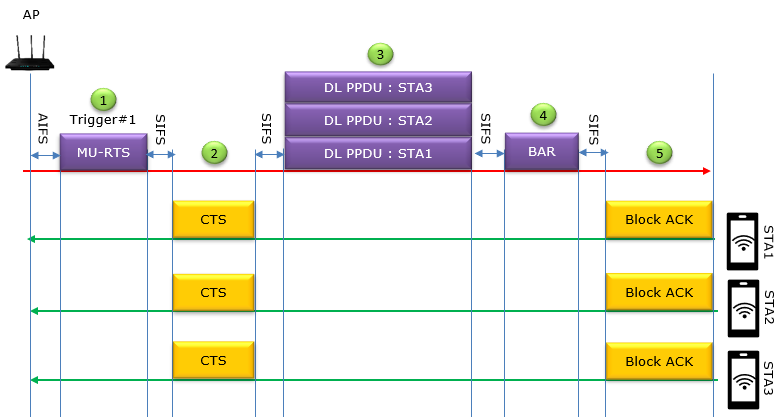
- Step (1) : the AP sends MU-RTS, labelled Trigger#1, after AIFS.
- Step (2) : STA1, STA2 and STA3 send CTS in the same time slot.
- Step (3) : the AP sends the DL PPDUs for the three STAs in the same time and spectrum, on different beams.
- Step (4) : the AP sends one BAR for all STAs. In 802.11ax, the Trigger frame type for this job is MU-BAR, Trigger Type 2.
- Step (5) : all three STAs send Block ACK together.
With three STAs, the acknowledgement part shrinks from three BAR and BA pairs to one BAR and one shared Block ACK slot. When the STAs send data in the uplink, the AP uses a Basic Trigger frame. Its User Info field gives each STA an RU Allocation, an MCS, a UL Length and a Target RSSI. Target RSSI is the power at which the AP wants to receive that STA. This matters for UL MU-MIMO, because the AP must separate streams that arrive at the same time on the same RU. A STA that arrives much stronger than the others makes the weaker streams harder to separate.
Uplink multi-user support removes the serial steps : CTS and Block ACK come back from all STAs at once.Trigger frames drive the uplink : the AP decides the RU, the MCS, the length and the target receive power for each STA.
How does the AP learn the channel for MU-MIMO ?
Every beam in the sections above assumes that the AP knows the channel to each STA. Let's see how the AP gets that knowledge, because the cost of getting it limits how often MU-MIMO pays off.
There are two ways to get the channel state information, CSI. In implicit feedback, the AP estimates the channel from the training sequences in frames that the STAs send, and it assumes that the uplink and downlink channels are reciprocal. This costs little air time, but the transmit and receive paths differ, so the antennas usually need calibration. In explicit feedback, the AP sends a training sequence, each STA estimates the channel, and each STA sends the CSI back. 802.11ac uses explicit feedback, with a compressed format called explicit compressed feedback, ECFB.
On the air, explicit sounding uses dedicated frames. Wireshark decodes a VHT NDP Announcement for 802.11ac and an HE NDP Announcement for 802.11ax. The announcement is followed by an NDP, a PPDU that carries training fields and no data. The AP then collects the reports from the STAs. In 802.11ac it uses the Beamforming Report Poll control frame, and in 802.11ax it uses the Beamforming Report Poll variant of the Trigger frame, Trigger Type 1.
The sounding time and the CSI volume grow with the number of AP antennas. The CSI also gets old as the STAs move. So the AP has to balance two costs. Frequent sounding uses air time, and rare sounding leaves outdated CSI, which causes interference between the parallel streams. The 802.11ac amendment does not specify how often to sound or how to group the STAs, so these choices are left to the vendor.
Explicit feedback is the 802.11ac method : the STAs measure and report, and the AP computes the precoder.Sounding is overhead : its air time grows with the AP antenna count.Old CSI turns into interference : the streams leak into each other when the channel has changed since the last sounding.
References :
- MU-MIMO MAC Protocols for Wireless Local Area Networks: A Survey (Nov 2014)
- Very High Throughput (VHT) Multi-User Multiple Input Multiple Output (MU-MIMO) Communication in 802.11ac (2015)
- 802.11ac MU-MIMO: Bridging the MIMO Gap in Wi-Fi (Jan 2015)
- Multi-User MIMO in WiFi 6
- How Does MU-MIMO Work? (Jun 2016)
- Meraki MR SU-MIMO, MU-MIMO, and Beamforming (Oct 2020)
- The MU-RTS/CTS process in the HE (802.11ax) - standard - Gjermund Raaen
- UL OFDMA, basic Trigger Frame and Multi-STA BlockAck (Aug 2019) - Gjermund Raaen
- packet-ieee80211.c - Wireshark IEEE 802.11 dissector, Trigger Type and NDP Announcement names
YouTube