The IP Multimedia Subsystem (IMS) is the service-control architecture used to deliver SIP based multimedia services such as VoLTE, VoNR, video calling, conferencing, messaging, and other operator services. IMS separates access, session control, subscriber data, policy control, application logic, and media interworking so that the same service framework can be used over LTE, 5G, Wi-Fi, and fixed broadband access.
At the center of the architecture are the Call Session Control Functions (P-CSCF, I-CSCF, and S-CSCF), which route SIP signaling and apply registration and session-control logic. Subscriber and service data is held in HSS or 5G-UDM, while PCRF or PCF applies policy and charging control. Application servers provide service features, and gateway functions such as MGCF and MGW connect IMS to legacy circuit-switched networks.
This page describes the main IMS components first, then summarizes the important interfaces and protocols that connect them. The interface section is useful when tracing registration, call setup, PSTN interworking, media control, and policy interactions across the IMS network.
Contents
Below is an illustration showing the essence of entire IMS network and its interaction to other network like cellular network and PSTN.
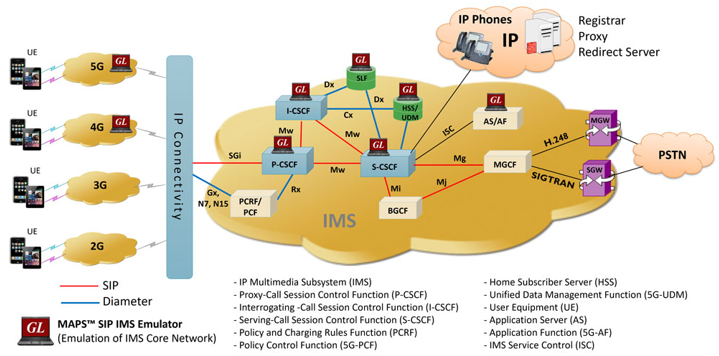
Image Source :IP Multimedia Subsystem (IMS) Emulator
Components of IMS Network
The IMS network is built from control-plane, subscriber-data, policy, application, and gateway functions. Each function has a specific role in registration, session routing, service execution, policy enforcement, or interworking with non-IMS networks.
Core Components
The core components handle SIP entry, routing, serving control, and subscriber lookup. They are involved in nearly every IMS registration and session-establishment procedure.
The
The
The
P-CSCF (Proxy Call Session Control Function): - The first point of contact for a User Equipment (UE) in the IMS network.
- Responsible for forwarding SIP signaling between the UE and other IMS entities.
- Performs security functions like encryption/decryption and interacts with the PCRF for QoS and policy enforcement.
I-CSCF (Interrogating Call Session Control Function): - Acts as an entry point into an operator's IMS network from external networks.
- Responsible for querying the HSS or 5G-UDM via the Cx interface to determine the user's location and routing SIP requests to the appropriate S-CSCF.
S-CSCF (Serving Call Session Control Function): - The central node of the IMS network.
- Handles session control and ensures proper SIP signaling for services.
- Retrieves subscriber data from the HSS and enforces service-specific rules.
HSS (Home Subscriber Server) or 5G-UDM (Unified Data Management): - A centralized database for storing subscriber profiles, authentication credentials, and service-related information.
- Interacts with the S-CSCF to provide user data for call/session handling.
Additional Functional Components
Additional IMS functions extend the core by adding policy control, service execution, subscriber-location resolution, and PSTN interworking. These functions may not appear in every simple signaling trace, but they become important when QoS, charging, service triggering, roaming, or legacy connectivity is involved.
The
PCRF (Policy and Charging Rules Function): - Manages QoS policies and charging rules for IMS sessions.
- Ensures that resources are appropriately allocated based on policy and subscription.
MGCF (Media Gateway Control Function): - Facilitates interworking between the IMS network and the traditional circuit-switched PSTN.
- Controls the media gateway for converting media streams between IP and legacy networks.
SLF (Subscriber Location Function): - Resolves user location information when multiple HSS instances are deployed.
BGCF (Breakout Gateway Control Function): - Routes calls from IMS to the PSTN when the destination is not part of the IMS network.
AS/AF (Application Server/Application Function): - Hosts and executes multimedia services or value-added services (e.g., voicemail, conferencing).
- Communicates with IMS core via the ISC interface.
MGW (Media Gateway): - Bridges IMS and legacy networks (e.g., PSTN) by converting signaling and media formats.
Integration with Legacy Networks
IMS must support communication between IP-based SIP services and legacy circuit-switched networks such as PSTN and ISDN. This interworking allows IMS subscribers to call non-IMS users and allows calls from legacy networks to reach IMS subscribers.
For PSTN interworking, SIP signaling from the IMS core is routed toward gateway control functions such as BGCF and MGCF. Media is handled through MGW resources, where RTP/IP media can be converted to circuit-switched bearer formats under H.248/MEGACO control.
Native IP phones and IMS-capable clients can connect more directly through IMS registration and SIP session procedures. In those cases, legacy gateway functions are not needed unless the session terminates outside the IMS/IP domain.
- PSTN (Public Switched Telephone Network):
- IMS communicates with the legacy PSTN via the MGCF and MGW using SIGTRAN protocols and H.248.
- IP Phones:
- These are directly integrated into the IMS core for multimedia communication services, bypassing legacy systems
Interfaces and Protocols
The IMS architecture is built on a robust framework of interfaces and protocols that facilitate seamless communication, session management, and interworking between various network elements. At its core, the IMS relies on the Session Initiation Protocol (SIP) for signaling and Diameter protocol for authentication, authorization, accounting, and policy control. These interfaces interconnect key components such as the Proxy, Interrogating, and Serving Call Session Control Functions (P-CSCF, I-CSCF, S-CSCF), the Home Subscriber Server (HSS), and the Policy and Charging Rules Function (PCRF). They enable critical functionalities like user authentication, session establishment, quality of service (QoS) management, and subscriber data retrieval. Additionally, H.248/MEGACO and SIGTRAN protocols ensure efficient interworking with legacy networks like the Public Switched Telephone Network (PSTN), while application interfaces provide access to value-added multimedia services. Together, these interfaces and protocols enable IMS to deliver a wide range of IP-based multimedia services with high reliability, interoperability, and scalability.
Gx Interface
The Gx interface is a critical link within the IMS architecture that connects the Policy and Charging Rules Function (PCRF) to other network elements, such as the P-CSCF or Packet Gateway (P-GW), depending on the scenario. It uses the Diameter protocol to facilitate the exchange of policy and charging control information. This interface plays a key role in managing Quality of Service (QoS) rules and ensuring that data sessions are aligned with user-specific policies and subscription details, enabling efficient and optimized service delivery.
- Purpose: Connects the P-GW or another policy enforcement function to the PCRF.
- Protocol: Diameter
- Functionality:
- Carries policy and charging control information.
- Manages QoS rules for data sessions.
Rx Interface
The Rx interface serves as a connection between the Proxy Call Session Control Function (P-CSCF) and the Policy and Charging Rules Function (PCRF) within the IMS architecture. Utilizing the Diameter protocol, it facilitates the exchange of service-level session information, allowing the network to dynamically apply Quality of Service (QoS) policies. This interface ensures that multimedia sessions adhere to the user's subscription and service requirements, optimizing resource allocation and enhancing the overall quality of the user experience.
- Purpose: Connects the P-CSCF to the PCRF.
- Protocol: Diameter
- Functionality:
- Used for exchanging service-level session information.
- Enables the IMS network to enforce QoS policies for specific sessions.
Cx Interface
The Cx interface is a vital link in the IMS architecture that connects the Serving Call Session Control Function (S-CSCF) to the Home Subscriber Server (HSS). It operates using the Diameter protocol to facilitate user authentication and authorization, ensuring secure access to the IMS network. Through this interface, the S-CSCF retrieves subscriber profiles and service-related information from the HSS, enabling proper user registration and seamless session control. This ensures that sessions are managed in alignment with the user's subscription and service entitlements.
- Purpose: Connects the S-CSCF to the HSS.
- Protocol: Diameter
- Functionality:
- Facilitates user authentication and authorization.
- Retrieves user profile and service information from the HSS.
- Ensures proper registration and session control.
Dx Interface
The Dx interface is an essential connection within the IMS architecture that links the Interrogating Call Session Control Function (I-CSCF) to the Subscriber Location Function (SLF). Using the Diameter protocol, it allows the I-CSCF to query the appropriate Home Subscriber Server (HSS) for a specific subscriber's data. This interface is particularly crucial in networks with multiple HSS instances, as it ensures that signaling requests are accurately routed to the correct HSS, enabling efficient and seamless session management.
- Purpose: Connects the I-CSCF to the SLF (Subscriber Location Function).
- Protocol: Diameter
- Functionality:
- Queries the correct HSS for a particular subscriber.
- Helps route requests within a network with multiple HSS instances.
Mw Interface
The Mw interface serves as the primary communication link between P-CSCF, I-CSCF, and S-CSCF within the IMS architecture. It operates using the SIP to handle signaling messages necessary for establishing, modifying, and terminating multimedia sessions. This interface enables seamless interaction and coordination among the CSCF components, ensuring efficient session control and service delivery across the IMS network.
- Purpose: Connects the P-CSCF, I-CSCF, and S-CSCF components.
- Protocol: SIP
- Functionality:
- Transfers SIP signaling messages for session establishment, modification, and termination.
- Provides interaction between different CSCF components.
Mi Interface
The Mi interface connects the Breakout Gateway Control Function (BGCF) to the Media Gateway Control Function (MGCF) within the IMS network. Using the Session Initiation Protocol (SIP), it handles signaling required for routing calls from the IMS core network to the Public Switched Telephone Network (PSTN). This interface ensures smooth interworking between IP-based IMS services and traditional circuit-switched telephony systems.
- Purpose: Connects the BGCF to the MGCF.
- Protocol: SIP
- Functionality:
- Manages the signaling required for call routing from the IMS core to PSTN.
Mg Interface
The interface between the MGCF and the MGW uses the H.248 (MEGACO) protocol to enable efficient control of media resources. It is responsible for managing the setup, modification, and teardown of media streams, facilitating the conversion between IP-based media and circuit-switched formats. This interface ensures smooth media interworking and signaling integration, allowing seamless communication between IMS-based services and legacy PSTN systems.
- Purpose: Connects the Media Gateway Control Function (MGCF) to the Media Gateway (MGW).
- Protocol: H.248 (MEGACO)
- Functionality:
- Controls media terminations and media contexts in the MGW.
- Enables the MGCF to allocate, modify, and release MGW media resources for PSTN interworking.
- Supports conversion between RTP/IP media and circuit-switched bearer resources.
ISC Interface
The ISC interface is a critical component within the IMS architecture that links the Serving Call Session Control Function (S-CSCF) with Application Servers (AS) or Application Functions (AF). Utilizing the Session Initiation Protocol (SIP), this interface enables dynamic interaction between the IMS core network and application servers, facilitating the deployment of value-added services such as voicemail, conferencing, and messaging. By seamlessly integrating application-layer functionality with session management and signaling, the ISC interface enhances the flexibility and scalability of the IMS network, ensuring personalized and enriched multimedia experiences for users.
- Purpose: Connects the S-CSCF to the Application Server (AS/AF).
- Protocol: SIP
- Functionality:
- Enables interaction between the core IMS network and application servers.
- Used for deploying value-added services such as voicemail, conferencing, or messaging.
SGi Interface
The SGi interface establishes a connection between the IMS Core, specifically the Policy and Charging Rules Function (PCRF) or Policy Control Function (PCF), and external IP networks. It uses standard IP-based protocols, such as TCP or UDP, to facilitate seamless communication. This interface enables IMS users to access a wide range of external services, including the internet and other IP-based networks, ensuring efficient data flow and service delivery beyond the IMS domain.
- Purpose: Connects the IMS Core (PCRF/PCF) to external IP networks.
- Protocol: IP-based protocols (e.g., TCP/UDP)
- Functionality:
- Provides connectivity for IMS users to access external services like the internet or other IP-based networks.
SIGTRAN Interface
The SIGTRAN interface connects the Media Gateway Control Function (MGCF) to the Public Switched Telephone Network (PSTN) or Integrated Services Digital Network (ISDN). Using the SIGTRAN protocol, which carries SS7 signaling over IP, this interface ensures seamless signaling interworking between the IMS and legacy telephony systems. It facilitates critical functions such as call setup, routing, and teardown, enabling interoperability between modern IP-based services and traditional circuit-switched networks.
- Purpose: Connects the MGCF to the PSTN network.
- Protocol: SIGTRAN (SS7 over IP)
- Functionality:
- Ensures signaling interworking between the IMS and legacy PSTN/ISDN.
- Supports call setup, routing, and teardown.
H.248 Interface
The H.248 interface links the Media Gateway Control Function (MGCF) to the Media Gateway (MGW) within the IMS network. It uses the H.248 (MEGACO) protocol to manage and control media channels between IP-based and circuit-switched networks. This interface is responsible for allocating, modifying, and releasing media resources, ensuring smooth handling of voice and data streams during interworking between IMS and legacy telephony systems like the PSTN
- Purpose: Connects the MGCF to the Media Gateway (MGW).
- Protocol: H.248 (MEGACO)
- Functionality:
- Used for controlling media channels between IP and circuit-switched networks.
- Responsible for media resource allocation and release.
N7/N15 Interfaces
The N7/N15 interfaces are key components in the 5G architecture, connecting the Policy Control Function (PCF) to other network entities. These interfaces use the HTTP/2 protocol to enable efficient and reliable communication. Their primary function is to provide policy-related information and manage session parameters, ensuring that network resources are allocated according to user subscriptions and Quality of Service (QoS) requirements. This facilitates seamless service delivery and enhanced user experiences in a 5G environment.
- Purpose: Connects the Policy Control Function (PCF) to other components.
- Protocol: HTTP/2
- Functionality:
- In a 5G context, provides policy information and session management.