Curl measures how much a vector field turns around a point. Picture a small paddle wheel placed in flowing water. If the water pushes harder on one side of the wheel than on the other, the wheel spins. Curl is the number that says how fast it spins and about which axis. This page builds the 2D formula from two neighbouring arrows, and then extends it to three dimensions. If vector fields are new to you, start with the Vector Field page.
- What Does the 2D Curl Formula Say?
- Where Do the Two Partial Derivatives Come From?
- Why Are the Two Directions at 90 Degrees?
- How Does Curl Work in Three Dimensions?
- How Do the Numbers Come Out for Simple Fields?
What Does the 2D Curl Formula Say?
Let's start with a field that lives in the flat x-y plane. At every point the field has two components, Fx along x and Fy along y. Each component can change in two directions, so there are four partial derivatives in total. The 2D curl uses only two of them, and the choice of those two is the whole idea.
The formula below writes the 2D curl as a vector along the z axis. The labels above it mark which field component each partial derivative is taken from.
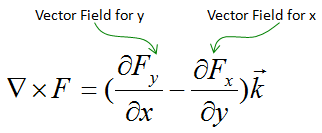
Figure 1. 2D curl of F = (Fx, Fy). The result points along k, out of the plane, because a rotation in the x-y plane turns about the z axis.
The first term takes the y component and differentiates it along x : ∂Fy/∂x asks how the vertical push changes when you step sideways. The picture labels it "Vector Field for y".The second term takes the x component and differentiates it along y : ∂Fx/∂y asks how the horizontal push changes when you step upward. The picture labels it "Vector Field for x".The minus sign sets the direction of rotation : a positive result means counterclockwise rotation seen from above, following the right hand rule. A negative result means clockwise rotation.The other two derivatives are not part of curl : ∂Fx/∂x and ∂Fy/∂y measure how each component changes along its own direction. They describe spreading, and they belong to Divergence.
Where Do the Two Partial Derivatives Come From?
The formula looks arbitrary until you zoom into the field and compare two nearby arrows. Each term then turns out to be the difference between two arrow components, divided by the distance between the arrows. That is the ordinary slope from the Slope/Derivative page, applied to one component at a time.
The left side of the diagram below plots a 2D vector field on a grid from -2 to 2. The arrows circle the origin clockwise, and they get longer away from the centre. The shaded square is enlarged on the right. It holds two arrows, one at (x, y) and one at (x + Δx, y + Δy). Each arrow is split into a red vertical part and a green horizontal part.
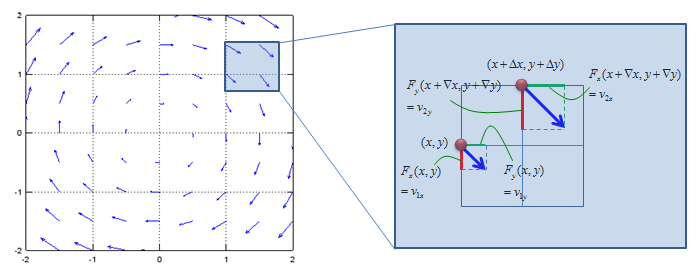
Figure 2. Zooming into a vector field. Each arrow is split into Fx, drawn green, and Fy, drawn red, so that each component can be compared between the two points.
The lower arrow gives v1x and v1y : these are Fx(x, y) and Fy(x, y), the components at the starting point.The upper arrow gives v2x and v2y : these are the same two components at the neighbouring point.The labels at the upper point use ∇x and ∇y : read them as Δx and Δy, the small steps in the coordinate label right above them. The symbol ∇ is the del operator, and it means something else.
The diagram below takes the two arrows out of the grid and lines up their components. The red bars are compared to get the change in Fy. The green bars are compared to get the change in Fx.
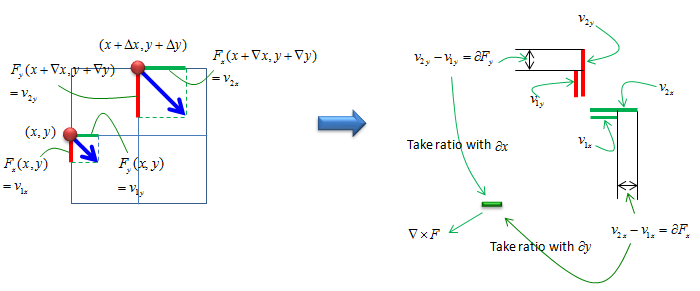
Figure 3. From two arrows to the curl. Each change in a component is divided by the step in the other direction, and the difference of the two ratios is the curl.
v2y - v1y is ∂Fy : the change in the vertical component. Dividing it by the horizontal step ∂x gives the first term of the curl.v2x - v1x is ∂Fx : the change in the horizontal component. Dividing it by the vertical step ∂y gives the second term.The drawing moves diagonally, but a partial derivative does not : ∂Fy/∂x compares two points that differ only in x, and ∂Fx/∂y compares two points that differ only in y. The diagonal pair shows the idea. For an exact value, keep the other coordinate fixed in each ratio.A uniform field has zero curl : if every arrow is identical, both differences are zero. A field that only moves things along does not turn them.
Why Are the Two Directions at 90 Degrees?
Each term of the curl pairs a field component with a step that is perpendicular to it. This pairing separates curl from divergence. It is also the reason the result points out of the plane rather than along it.
The diagram below marks, for each term, the direction in which the component changes and the direction in which the step is taken.
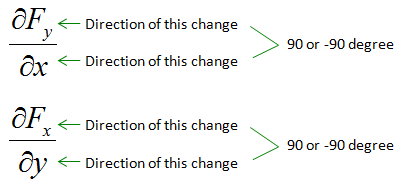
Figure 4. In both terms the component and the step are perpendicular. A change across the flow, not along it, is what makes the field turn.
∂Fy/∂x pairs y with x : Fy points along y, and the step is along x. The two directions are at 90 degrees.∂Fx/∂y pairs x with y : Fx points along x, and the step is along y. The angle is again 90 degrees, measured the other way, which is why the two terms carry opposite signs.Straight flow can still turn a paddle wheel : suppose water in a channel flows along x, faster at larger y. Fx changes as you move in y, so the curl is not zero. A paddle wheel placed in this flow spins, although every stream line is straight.Divergence uses the parallel pairs : ∂Fx/∂x + ∂Fy/∂y compares each component along its own direction. So it measures spreading, while curl measures turning.
How Does Curl Work in Three Dimensions?
In three dimensions a field can turn about any axis, not only about z. So the curl becomes a full vector with three components. Each component is the 2D curl seen in one coordinate plane.
The plot below shows a 3D field whose arrows circle a vertical axis. A green plane cuts through the field, and the curved green arrows show the flow turning around a vertical green bar. The red arrow is the curl vector. It lies along the axis of rotation and points downward here.
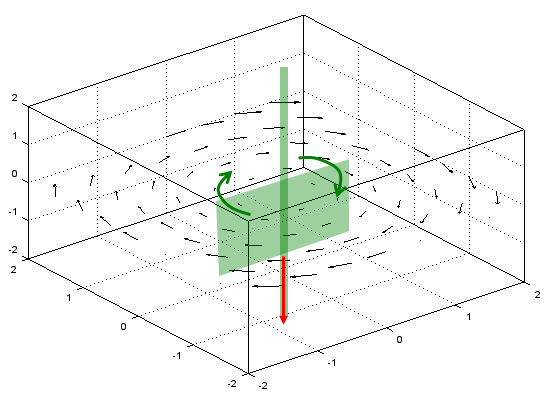
Figure 5. The curl vector points along the axis of rotation. Its length gives the rotation rate, and its direction follows the right hand rule.
The right hand rule links the two. Curl the fingers of your right hand in the direction of the flow, and your thumb points along the curl. A curl pointing down therefore means the flow turns clockwise when seen from above.
The full 3D formula below has three terms. Each term is the formula of Figure 1, written for one pair of axes.
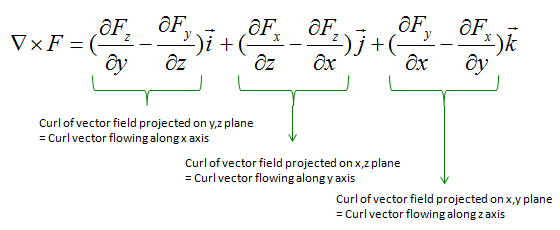
Figure 6. 3D curl as three 2D curls. The i term measures rotation in the y-z plane, the j term in the x-z plane and the k term in the x-y plane.
The k term is the 2D curl : set Fz = 0 and let Fx and Fy depend only on x and y. The i and j terms vanish, and Figure 1 remains.The indices follow the cycle x, y, z : the i term starts with ∂Fz/∂y, the j term with ∂Fx/∂z and the k term with ∂Fy/∂x. Each second term swaps the two letters. A sign error usually means this cycle was broken.The formula is a determinant : put i, j, k in the first row, ∂/∂x, ∂/∂y, ∂/∂z in the second row and Fx, Fy, Fz in the third. Expanding along the first row gives Figure 6.Read "flowing along" an axis as "rotating about" it : the labels in Figure 6 use the first wording. The i component measures turning in the y-z plane, and the axis of that turning is x.
How Do the Numbers Come Out for Simple Fields?
Let's check the formula on four fields that are easy to picture. Each one isolates a single idea: turning one way, turning the other way, spreading without turning, and turning without circling. Every value in the table below comes straight from Figure 1.
Field |
F = (Fx, Fy) |
∂Fy/∂x |
∂Fx/∂y |
Curl, k component |
What the arrows look like |
Rotation, counterclockwise |
(-y, x) |
1 |
-1 |
2 |
Circles around the origin, counterclockwise |
Rotation, clockwise |
(y, -x) |
-1 |
1 |
-2 |
Circles around the origin, clockwise, as in Figure 2 |
Radial |
(x, y) |
0 |
0 |
0 |
Straight out from the origin. The divergence is 2, but nothing turns |
Shear |
(y, 0) |
0 |
1 |
-1 |
Parallel arrows along x, longer at larger y |
The two rotation rows have the same shape and opposite signs, which is the right hand rule at work. Notice that a rigid rotation gives 2, not 1. The field (-y, x) turns every point at an angular velocity of 1, and curl is twice the local angular velocity.
A 3D example uses all three terms. For F = (xy, yz, zx), the i term is 0 - y, the j term is 0 - z and the k term is 0 - x. So the curl is (-y, -z, -x). At the point (1, 2, 3) it is (-2, -3, -1).
Curl measures turning, not curved arrows : the shear field has straight arrows and a curl of -1. The opposite also happens. The field (-y, x)/(x2 + y2) circles the origin, yet its curl is 0 everywhere except at the origin itself.Curl is twice the local angular velocity : a paddle wheel at a point spins at half the curl, in the direction the right hand rule gives.A gradient field never turns : the curl of the gradient of any smooth function f is zero. So a field that comes from a potential, as on the Gradient page, always has zero curl.The divergence of a curl is always zero : for the 3D example, the divergence of (-y, -z, -x) is 0 + 0 + 0. This holds for every smooth field, not only this one.