Bluetooth is the short range radio that connects a phone to a headset, a car, a watch or a keyboard. This page starts from a one-paragraph definition and five basic questions. Then it puts the numbers of the Bluetooth Core Specification behind each answer, shows how Bluetooth shares the crowded 2.4 GHz band, and ends with the applications that made it common.
- What is Bluetooth ?
- What do the basic numbers look like ?
- How does Bluetooth share the 2.4 GHz band ?
- Typical Bluetooth Applications
- Reference
What is Bluetooth ?
As most of you do when you want to know anything you'd never heard of... try wikipedia. The definition quoted below is short, but it already answers most of the basic questions about the technology. After the quote, we check each answer against the specification itself.
It (http://en.wikipedia.org/wiki/Bluetooth) says as follow.
To understand any kind of communication technology, you should be able to answer to several basic questions about it. In other words, if you can answer the following questions, I would say you already have some general understanding on it.
- Is it wired communication ? or Wireless communication ?
- If it is wireless communication, what kind of wave length (frequency) range it uses ?
- What is the typical range of communication ? (How far it can go) ?
- What is the typical data rate you can transmit and receive ?
- What is the typical connection topology ? (Is it one-to-one connection ? or one-to-many connection ? etc)
Can you find the answers to these questions from the wikipedia definition that I quoted above ?
Let's tackle each of the questions one by one.
- Is it wired communication ? or Wireless communication ? ==> It is 'wireless Communication'.
- If it is wireless communication, what kind of wave length (frequency) range it uses ? ==> It is 2400~2483.5 Mhz frequency Range called ISM (Industrial Science Medical) band.
- What is the typical range of communication ? (How far it can go) ? ==> It is usually a couple meter range (The wikipedia definition does not explictely say about the range though)
- What is the typical data rate you can transmit and receive ? ==> At the beginning, it started with the max data rate of 1 Mbps and now mostly 2,3 Mbps (EDR). Recent specification defines the technology for even higher data rate.
- What is the typical connection topology ? (Is it one-to-one connection ? or one-to-many connection ? etc) ==> It support both one-to-one and one-to-many connection.
Some of these answers need a correction or more detail, and the next section gives it. The frequency answer is the most important one. The 2.4 GHz ISM band is 2400 MHz to 2483.5 MHz, and every Bluetooth channel sits inside it. The range answer depends on the transmit power class, so a class 1 device reaches much further than a couple of meters.
Five questions describe any radio technology : medium, frequency, range, data rate and topology.Bluetooth is a 2.4 GHz ISM radio : it shares that unlicensed band with WiFi, microwave ovens and many other devices.
What do the basic numbers look like ?
Let's replace the rough answers above with the values from the Bluetooth Core Specification. One thing to keep in mind first: Bluetooth today is two radios under one name. BR/EDR is the classic radio for audio and continuous data. LE, Low Energy, is a separate radio for small, infrequent data, and it is the one inside most sensors and wearables.
The two radios divide the band differently. BR/EDR uses 79 channels of 1 MHz, at f = 2402 + k MHz for k = 0 to 78. LE uses 40 channels of 2 MHz, from 2402 MHz to 2480 MHz. Both run at 1 M symbols per second in their basic mode. The table below lists the gross air data rates of each mode.
Radio |
Mode |
Modulation |
Gross data rate |
BR/EDR | Basic Rate | GFSK | 1 Mb/s |
BR/EDR | Enhanced Data Rate | pi/4-DQPSK | 2 Mb/s |
BR/EDR | Enhanced Data Rate | 8DPSK | 3 Mb/s |
LE | LE 1M | GFSK | 1 Mb/s |
LE | LE 2M | GFSK | 2 Mb/s |
LE | LE Coded | GFSK with coding | 500 kb/s or 125 kb/s |
EDR keeps the symbol rate at 1 Msym/s and puts more bits in each symbol, 2 bits with pi/4-DQPSK and 3 bits with 8DPSK. LE 2M doubles the symbol rate instead. LE Coded goes the other way, and it trades rate for range with error-correcting coding. The access code and header of an EDR packet still use GFSK, so a Basic Rate device can always read the start of any packet.
The range depends on the power class. The table below shows the three BR/EDR power classes. In free space, the range grows by 10 times for every 20 dB of extra power. So a class 1 device at 20 dBm can reach about 10 times further than a class 3 device at 0 dBm, if the receivers are the same. That is why the answer "a couple meter range" above fits only the low power classes.
Power class |
Maximum output power Pmax |
1 | 100 mW, 20 dBm, down to above 2.5 mW, 4 dBm |
2 | 2.5 mW, 4 dBm, down to above 1 mW, 0 dBm |
3 | 1 mW, 0 dBm, or less |
The topology answer also has an exact form. Two or more devices that share one physical channel form a piconet. One device is the Central, and it controls access to the channel. The others are Peripherals, and up to seven of them can be active at the same time. The current specification uses Central and Peripheral, and older documents call the same roles master and slave.
Two radios, one name : BR/EDR uses 79 channels of 1 MHz, and LE uses 40 channels of 2 MHz.1, 2 and 3 Mb/s are gross rates : packet headers, gaps between packets and retransmissions make the user data rate lower.Range follows the power class : 20 dB more transmit power gives about 10 times the free space range.A piconet has one Central : it schedules the channel for up to seven active Peripherals.
How does Bluetooth share the 2.4 GHz band ?
The 2.4 GHz band is unlicensed, so Bluetooth can never assume a clean channel. WiFi, other piconets and microwave ovens all use the same 83.5 MHz. Bluetooth handles this in a different way from WiFi. It does not stay on one channel and wait for it to be free. Instead, it keeps moving.
BR/EDR hops over its 79 channels. In a connection, the maximum hop rate is 1600 hops per second, and time is divided into slots of 625 microseconds, which is exactly 1 / 1600 of a second. The Central and the Peripheral take turns in these slots, and the frequency keeps changing along the hop sequence. A narrowband interferer therefore hits only the packets that land on its channel, and a retransmission goes out on a different channel.
Adaptive Frequency Hopping improves this further. The Central builds a channel map and removes the channels that are busy, for example the channels under an active WiFi network. The hop sequence then uses only the good channels. The specification sets a floor. Each link must still use at least 20 channels.
LE uses a different trick for discovery. Of its 40 channels, 3 are primary advertising channels, at 2402, 2426 and 2480 MHz. The other 37 are general purpose channels for most communication. Look where the three advertising channels sit. The 20 MHz WiFi channels 1, 6 and 11 are centred at 2412, 2437 and 2462 MHz, so they cover 2402 to 2422, 2427 to 2447 and 2452 to 2472 MHz. 2426 MHz falls in the gap between channels 1 and 6, and 2480 MHz lies above channel 11. So a typical WiFi network leaves at least two of the three advertising channels free.
Bluetooth avoids interference by moving : up to one new channel per 625 microseconds slot, or 1600 hops per second.AFH removes busy channels : the hop set can shrink from 79 to as few as 20 channels.LE advertising avoids the common WiFi channels : 2426 and 2480 MHz fall outside WiFi channels 1, 6 and 11.
Typical Bluetooth Applications
Now let's connect the numbers to real products. Each application below needs a different mix of data rate, latency and battery life, and that mix decides which Bluetooth radio fits it. The three picture strips below show thirteen applications, each with a photo and a label.
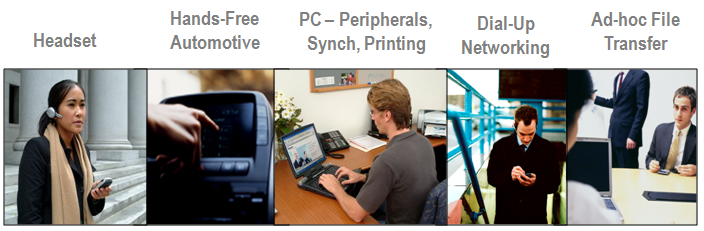
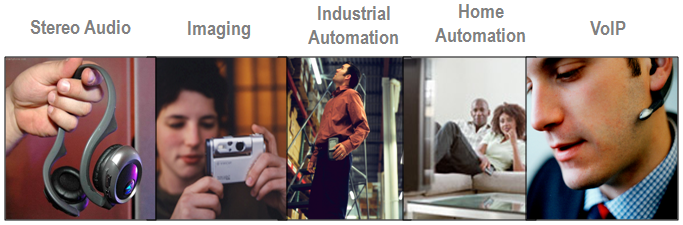
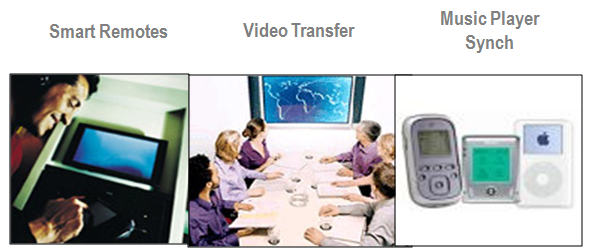
Figure 1. Typical Bluetooth applications in three strips. Most of them replace a short cable, and they fall into audio, data transfer and control.
Audio : Headset, Hands-Free Automotive, Stereo Audio and VoIP. These need a steady stream with low delay, which the slot structure of BR/EDR provides.Data transfer : PC - Peripherals, Synch, Printing, Dial-Up Networking, Ad-hoc File Transfer, Imaging, Video Transfer and Music Player Synch. These need the highest rate, so EDR at 2 or 3 Mb/s helps them most.Control : Industrial Automation, Home Automation and Smart Remotes. These send small amounts of data now and then, which is the case LE was designed for.
The strips come from the early years of Bluetooth, and some items show their age. Dial-up networking and music player synch have mostly disappeared. Other uses have grown instead, such as wearables, medical sensors and location beacons. All of these new uses run on LE, because they need years of battery life rather than a high rate.
Most applications replace a cable : this is the original goal of Bluetooth, a wireless alternative to RS-232 cables.The application decides the radio : continuous audio and file transfer fit BR/EDR, while small periodic data fits LE.
Reference
- Bluetooth Core Specification v6.2, Vol 2 Part A : BR/EDR Radio Specification
- Bluetooth Core Specification v6.2, Vol 2 Part B : Baseband Specification
- Bluetooth Core Specification v6.2, Vol 6 Part A : LE Physical Layer Specification
- Bluetooth Core Specification v6.2, Vol 6 Part B : LE Link Layer Specification
- Wikipedia : Bluetooth