5GMM, or 5G Mobility Management, is the sublayer within the 5G NAS protocol that governs how a mobile device connects to, remains registered with, and moves within the 5G core network. It is responsible for establishing and maintaining the device’s mobility context, ensuring that the network is always aware of the device’s availability and general location for service delivery. Through procedures such as registration, deregistration, mobility updates, and paging response, 5GMM enables seamless connectivity as the device powers on, changes locations, or transitions between different access technologies. It also plays a key role in initiating authentication, setting up security contexts, and coordinating with other NAS functions so that both signaling and user data are exchanged securely and reliably across the network.
5G Mobile Management is involved mainly in NAS registration process and in terms of corenetwork interface point of view, it is mostly associated with N1/N2 interface.
Major Functions of 5GMM
Some of the major functionality of 5GMM is as follows (as described in 24.501-5.1.2) .
In simple terms, 5GMM is the control framework that keeps the UE known, trusted, reachable, and properly managed by the 5G core network. It handles the full UE lifecycle, starting from registration when the device enters the network, maintaining security and configuration while the device is operating, waking the connection up when service is needed, and releasing the context when the UE leaves the network. It also supports special procedures such as paging, notification, and emergency-related handling. So even though user data itself is handled by other functions, 5GMM is the part that makes sure the network always knows who the UE is, where it is, and how to communicate with it securely and efficiently.
- registration
- de-registration
- eCall inactivity procedure
- connected mode procedure
- network-initiated NAS transport
- primary authentication and key agreement procedure
- security mode control
- generic UE configuration update
- identification
- UE-initiated NAS transport
- connection management procedure
- service request
- paging
- notification
Lifecycle Management
This group of procedures handles how the UE enters and leaves the 5G system.
Registration is the starting point. UE sends Registration Request to tell the network that it wants to join or update its presence in the system. Through this process, the network learns the UE identity, checks subscription and capability information, establishes security context, and creates the UE context needed for later communication. This is one of the most fundamental procedures in 5GMM.
De-registration is the opposite process. UE or network uses this procedure when the UE is leaving the system or when the existing registration context should be removed. This allows the network to release the related resources and stop treating the UE as an active registered device in that registration scope.
So this part of 5GMM controls the UE lifecycle from network entry to network exit.
-
Registration - Registration is the starting point of UE entry into the 5G system.
- UE sends Registration Request to tell the network that it wants to join the network or update its current presence.
- Through this procedure, the network learns the UE identity and checks subscription and capability information.
- The network also establishes the security context needed for protected NAS communication.
- This procedure creates the UE context that will be used for later communication and service handling.
- This is one of the most fundamental procedures in 5GMM because it is the basis for most other NAS operations.
-
De-registration - De-registration is the opposite of registration.
- UE or network uses this procedure when the UE is leaving the system or when the existing registration context needs to be removed.
- This allows the network to release the related context and reserved resources.
- After this procedure, the network no longer treats the UE as an active registered device in that registration scope.
-
Overall Meaning - This part of 5GMM controls the UE lifecycle from network entry to network exit.
- It provides the basic framework that allows the network to create, maintain, and remove UE presence in a controlled way.
Security Management
This group of procedures makes sure that the UE and the network can trust each other and can protect NAS signaling.
Primary Authentication and Key Agreement is the main security check. UE and network exchange authentication information so the network can verify that the subscriber is legitimate. At the same time, security keys are derived for later protection. This is the step that creates the trust relationship between UE and core network.
Security Mode Control is the next step after authentication. Network sends Security Mode Command to activate the selected NAS security algorithms. After this point, NAS messages can be protected by integrity and encryption. This prevents unauthorized modification and reduces the risk of signaling interception.
This means 5GMM is not just about mobility. It is also the main controller for NAS-level security establishment.
-
Primary Authentication and Key Agreement - This is the main security check between UE and the network.
- UE and network exchange authentication information so the network can verify that the subscriber is legitimate.
- During this procedure, security keys are derived for later protection of signaling.
- This step establishes the trust relationship between the UE and the 5G core network.
-
Security Mode Control - This procedure occurs after successful authentication.
- The network sends Security Mode Command to activate the selected NAS security algorithms.
- After this point, NAS messages can be protected by integrity protection and encryption.
- This prevents unauthorized modification of signaling and reduces the risk of interception.
-
Overall Role - This means 5GMM is not only about mobility management.
- It also acts as the main controller for NAS-level security establishment.
UE Configuration Management
After the UE is registered, the network may still need to update UE-related control information. This is handled by Generic UE Configuration Update.
In this procedure, the network can send updated parameters without forcing the UE to perform a full new registration. For example, the network may update temporary identity, allowed NSSAI information, tracking-related information, or other UE-specific settings. This makes the system more flexible because many changes can be applied dynamically while the UE remains registered.
So this function is like ongoing administrative management of the UE context.
-
Generic UE Configuration Update - This procedure allows the network to send updated UE-related control parameters after registration is already completed.
- The UE does not need to perform a full new registration just because some control information has changed.
- This makes the procedure efficient and reduces unnecessary signaling load.
-
What Can Be Updated - The network may update the temporary identity assigned to the UE.
- The network may update allowed NSSAI information related to slice access.
- The network may update tracking-related information or other UE-specific settings.
- In general, this procedure is used whenever the network needs to adjust UE control information while keeping the UE in the registered state.
-
Overall Meaning - This function makes the system more flexible because many updates can be applied dynamically.
- The UE can remain registered while the network refines or refreshes important control parameters.
- So this procedure works like ongoing administrative management of the UE context.
NAS Message Transport
5GMM also provides transport for certain NAS-level messages that are not pure mobility procedures by themselves.
NAS Transport works like a container. It allows the network or the UE to deliver certain upper-layer NAS information through a 5GMM procedure. In practical terms, this means 5GMM can carry messages related to other services while still using the NAS signaling path. This is why it is often described as an envelope or delivery mechanism inside NAS.
This is important because not every control message needs its own completely separate transport framework.
-
NAS Transport - NAS Transport works like a container inside 5GMM.
- It allows the network or the UE to deliver certain upper-layer NAS information through a 5GMM procedure.
- This means 5GMM can carry messages related to other services while still using the NAS signaling path.
-
How It Works - This procedure is often described as an envelope or delivery mechanism inside NAS.
- The transport framework is provided by 5GMM, but the actual information being carried may belong to another service or function.
- So 5GMM is not only handling its own mobility procedures. It can also act as a signaling carrier for related NAS information.
-
Why It Matters - This is important because not every control message needs its own completely separate transport framework.
- By reusing the existing NAS signaling path, the system becomes simpler and more efficient.
- This allows different NAS-related functions to exchange information without introducing unnecessary additional procedure structures.
Service Continuity and Wake-Up Handling
A UE is not always in an active data transfer state. Very often it stays in an idle or inactive state to save power and signaling load. 5GMM provides the procedures that bring the UE back into active service when needed.
Service Request is used when the UE already has registration context but needs to resume active service. For example, when a user opens an app and data transmission needs to start again, UE sends Service Request so the network can restore the required user-plane connectivity quickly. This avoids doing a full registration every time.
Paging is the network-initiated wake-up procedure. When the network has incoming data or signaling for a UE that is idle, the network broadcasts paging so the UE can detect it and respond. This is how the network finds and wakes a UE that is not currently in active signaling exchange.
Notification is a related but more specific alerting procedure. It is used by the network to inform the UE about incoming events or requests that require UE attention. Depending on the case, this may be tied to voice-related service or other network-initiated conditions.
This group of procedures is essential because it balances power saving and reachability. UE can sleep most of the time, but the network can still bring it back when service is needed.
-
Service Request - Service Request is used when the UE already has registration context but needs to resume active service.
- This typically happens when the UE is in idle or inactive state and new user activity starts.
- For example, when a user opens an app and data transmission needs to begin, the UE sends Service Request.
- The network then restores the required user-plane connectivity quickly.
- This avoids performing a full registration procedure every time service needs to resume.
-
Paging - Paging is the network-initiated wake-up procedure.
- When the network has incoming data or signaling for a UE that is idle, it broadcasts paging information.
- The UE detects the paging message and responds to it.
- This is how the network finds and wakes a UE that is not currently in active signaling exchange.
-
Notification - Notification is a related but more specific alerting procedure.
- It is used by the network to inform the UE about incoming events or requests that require UE attention.
- Depending on the case, this may be associated with voice-related service or other network-initiated conditions.
- So Notification is not just a generic wake-up. It is a targeted indication that some specific action or awareness is needed at the UE side.
-
Overall Meaning - This group of procedures is essential because it balances power saving and reachability.
- The UE can remain quiet most of the time to reduce battery usage and signaling load.
- At the same time, the network still has reliable methods to bring the UE back when service is needed.
- So these procedures are a key part of efficient 5G mobility and connection management.
Special Handling Procedures
Some 5GMM procedures exist for special or safety-critical situations.
One example is the eCall inactivity procedure. This is related to emergency service behavior. After an emergency call, the UE may remain in a special handling condition so that emergency authorities can reconnect or call back if needed. This is different from normal commercial service logic. The priority here is reliability and public safety, not just efficient resource release.
This shows that 5GMM is designed not only for normal daily traffic but also for exceptional service cases.
-
eCall Inactivity Procedure - One example is the eCall inactivity procedure.
- This procedure is related to emergency service behavior rather than normal commercial service handling.
- After an emergency call, the UE may remain in a special handling condition.
- This allows emergency authorities to reconnect or call back if needed.
- The purpose is to maintain emergency accessibility even after the main emergency communication has ended.
-
Why It Is Different - This behavior is different from normal commercial service logic.
- In ordinary cases, the network would focus on efficient release of resources after activity ends.
- In this case, the higher priority is reliability and public safety.
- So the network may preserve a special handling state instead of returning immediately to normal behavior.
-
Overall Meaning - This shows that 5GMM is designed not only for normal daily traffic.
- It also includes support for exceptional and safety-critical service cases.
- So 5GMM covers both routine mobility management and special procedures required for emergency-related operation.
Relationship with Other NAS Functions
It is important to separate 5GMM from 5GSM.
5GMM handles the UE control side. It manages identity, reachability, registration, security, and mobility-related signaling.
5GSM handles PDU session and data connectivity side. It manages the user data session itself, such as creating and maintaining the data path used by applications.
So the relationship is simple. 5GMM manages the UE presence and control context. 5GSM manages the actual data session. Without 5GMM, the network would not know how to securely identify and reach the UE. Without 5GSM, the UE would not have the user-plane session needed for data service.
-
5GMM - 5GMM handles the UE control side of NAS operation.
- It manages UE identity, reachability, registration, security, and mobility-related signaling.
- Its main role is to maintain the UE presence and control context in the 5G core network.
-
5GSM - 5GSM handles the PDU session and data connectivity side.
- It manages the user data session itself.
- This includes creating, modifying, and maintaining the data path used by applications.
-
How They Work Together - The relationship is simple. 5GMM manages the UE presence and control context, and 5GSM manages the actual data session.
- Without 5GMM, the network would not know how to securely identify the UE, keep track of it, or reach it when needed.
- Without 5GSM, the UE would not have the user-plane session required for actual data service.
- So 5GMM and 5GSM are different in role, but they work together to provide complete NAS operation in 5G.
Why This Matters
These 5GMM functions are fundamental because every UE must be controlled before it can be served. The network must know who the UE is, whether it is allowed on the network, where it is approximately located, whether its signaling is protected, and how to wake it when traffic arrives. All of this is handled by 5GMM.
So the easiest way to understand 5GMM is this. It is the network control manager for the UE. It brings the UE into the system, protects it, keeps track of it, updates it, wakes it up when needed, and removes it cleanly when service ends.
-
What the Network Needs to Know - The network must know who the UE is.
- The network must know whether the UE is allowed on the network.
- The network must know where the UE is approximately located.
- The network must know whether NAS signaling is protected.
- The network must know how to wake the UE when traffic or signaling arrives.
- All of this is handled by 5GMM.
-
How to Understand 5GMM - The easiest way to understand 5GMM is to see it as the network control manager for the UE.
- It brings the UE into the system through registration.
- It protects the UE through authentication and NAS security procedures.
- It keeps track of the UE through mobility and reachability management.
- It updates UE-related control information when needed.
- It wakes the UE up when service is required.
- It removes the UE cleanly when service ends.
-
Overall Meaning - Without 5GMM, the network would not have the control framework needed to manage UE presence and trust.
- So 5GMM is one of the most essential NAS functions in the 5G system.
- It provides the control foundation that allows all other network services to operate properly for the UE.
5GMM Statemachine
5GMM is very complicated process described in about 150 pages in 24.501 and you would easily get lost if you directly jumping into reading the details. My recommendation is to try to get familiar with the following statemachine to the point where you can draw the statemachine by hands and then read the specification as-you-need basis.
It describes how the UE moves between different mobility management states during its interaction with the 5G core network. The earlier explanation of 5GMM focused on the functions such as registration, authentication, paging, and service request. This state machine shows how those functions are organized in time and how the UE transitions from one operational condition to another. In other words, it shows the control logic that governs when each 5GMM procedure can occur.
Overall, the 5GMM state machine provides a structured control framework for UE mobility management. It defines the valid operational states and the allowed transitions between them. This structure ensures that procedures such as registration, service request, paging response, and deregistration occur in a predictable and controlled order. For engineers and developers, this state machine is extremely useful because it provides a clear map for understanding UE behavior and diagnosing signaling problems in real network logs.
5GMM main states in the UE
GMM states on UE side is specified / summarized as shown below.
< 24.501 Figure 5.1.3.2.1.1.1: 5GMM main states in the UE >
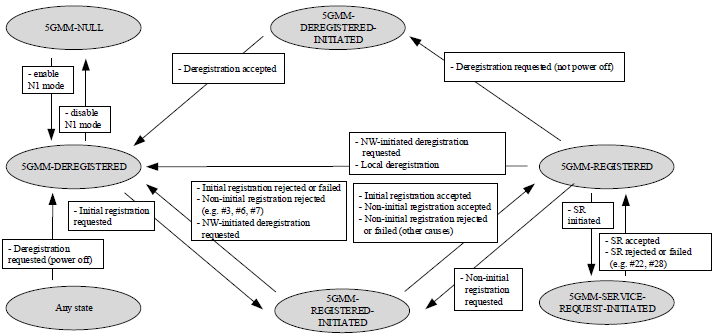
Followings are brief description on each of the states. Understanding the details of each of the status and transition trigger would be helpful for you to troubleshoot various NAS issues from UE log.
- 5GMM-NULL: This state represents the initial condition when the UE is powered on or reset. In this state, 5GS services are disabled in the UE. No 5GS mobility management function shall be performed in this state. The UE is not registered to any 5G network, and no context is stored in the network for the UE. The UE is not reachable for mobile-terminated services.
- 5GMM-DEREGISTERED: In this state, the UE is not registered to any 5G network. No 5GMM context has been established and the UE location is unknown to the network and hence it is unreachable by a network. In order to establish a 5GMM context, the UE shall start the initial registration procedure. It is either switched off, out of coverage, or has been deregistered from the network for some reason. The UE is not reachable for mobile-terminated services, and no context is stored in the network for the UE.
- 5GMM-DEREGISTERED-INITIATED: This state indicates that the UE has initiated the deregistration process but has not yet completed it. The UE is in the process of exchanging messages with the network to complete the deregistration.
- 5GMM-REGISTERED-INITIATED: In this state, the UE has initiated the registration process but has not yet completed it. The UE is in the process of exchanging messages with the network to complete the registration.
- 5GMM-REGISTERED: This state indicates that the UE has successfully registered with a 5G network. In this state, the UE can receive mobile-terminated services, and the network maintains context information for the UE. This state implies that the UE has successfully completed the registration process and can now utilize network services.
- 5GMM-SERVICE-REQUEST-INITIATED: In this state, the UE has initiated a service request to the network to establish a connection. This typically occurs when the UE needs to access specific network services or resources (e.g., to initiate a data session or a voice call). The UE remains in this state until the service request is either granted or rejected by the network.
According to 24.501 - 5.1.3.2.1.3 and 5.1.3.2.1.4, various substatus are defined as summarized below.
|
Main 5GMM State |
Sub-State |
Description |
|---|---|---|
|
5GMM-DEREGISTERED |
5GMM-DEREGISTERED.NORMAL-SERVICE |
UE is not registered and actively searching for a network to register with. |
|
5GMM-DEREGISTERED.LIMITED-SERVICE |
UE has limited network access, typically due to an emergency or restricted access for specific services. |
|
|
5GMM-DEREGISTERED.ATTEMPTING-REGISTRATION |
UE is attempting to register with a network but has not yet completed the process. |
|
|
5GMM-DEREGISTERED.PLMN-SEARCH |
UE is searching for a suitable Public Land Mobile Network (PLMN) to register with. |
|
|
5GMM-DEREGISTERED.NO-SUPI |
UE does not have a Subscription Permanent Identifier (SUPI) or is not able to use it for registration. |
|
|
5GMM-DEREGISTERED.NO-CELL-AVAILABLE |
UE is not able to find a suitable cell to register with or is out of coverage. |
|
|
5GMM-DEREGISTERED.eCALL-INACTIVE |
UE is not registered and not actively searching for a network, with eCall functionality inactive. |
|
|
5GMM-DEREGISTERED.INITIAL-REGISTRATION-NEEDED |
UE needs to perform an initial registration with a network. |
|
|
5GMM-REGISTERED |
5GMM-REGISTERED.NORMAL-SERVICE |
UE is registered and has normal network access for all services. |
|
5GMM-REGISTERED.NON-ALLOWED-SERVICE |
UE is registered but does not have access to specific services, as defined by the network. |
|
|
5GMM-REGISTERED.ATTEMPTING-REGISTRATION-UPDATE |
UE is attempting to update its registration with the network, typically due to mobility or changes in the network. |
|
|
5GMM-REGISTERED.LIMITED-SERVICE |
UE has limited network access, typically due to an emergency or restricted access for specific services. |
|
|
5GMM-REGISTERED.PLMN-SEARCH |
UE is searching for a new PLMN while still being registered |
|
|
5GMM-REGISTERED.NO-CELL-AVAILABLE |
UE is registered but there is no cell available for communication. |
|
|
5GMM-REGISTERED.UPDATE-NEEDED |
UE needs to update its registration information, typically due to changes in subscription data or network configuration. |
5GMM main states in the network
GMM states on Network side is specified / summarized as shown below. This statemachine shows the 5GMM main states on the network side, which are maintained inside the AMF (Access and Mobility Management Function). The purpose of this state machine is to track the registration status of each UE from the network perspective. While the UE maintains its own 5GMM state locally, the network must maintain a matching state so that both sides agree on whether the device is registered, undergoing a procedure, or deregistered. The diagram illustrates how the AMF transitions between these states during registration, common procedures, and deregistration events.
Overall, this network-side state machine ensures that the AMF always maintains an accurate view of each UE's mobility management status. Together with the UE-side state machine, it forms a coordinated control system that governs registration, authentication, service activation, and deregistration in the 5G NAS architecture.
< 24.501 Figure 5.1.3.2.3.1.1: 5GMM main states in the network >
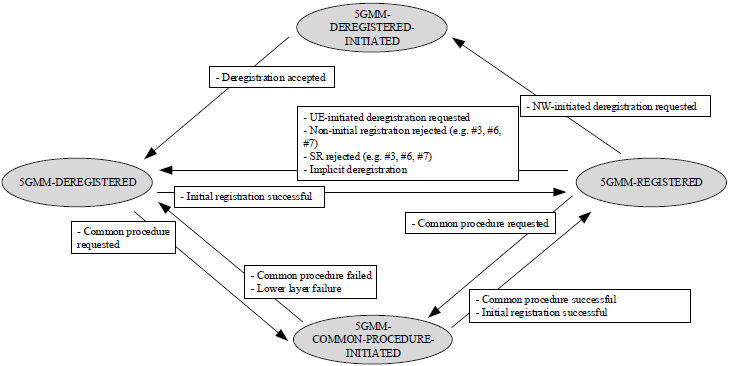
Followings are brief description on each of the states
- 5GMM-DEREGISTERED:
- UE: Not registered to the network and cannot access network services.
- Network: In this state, the network does not provide any services to the UE. The network can still monitor for registration attempts from the UE and be ready to process any incoming registration requests. The network can also initiate paging if the UE had a valid registration earlier and needs to be reached for incoming communication.
- 5GMM-DEREGISTERED-INITIATED:
- UE: Initiated a deregistration process with the network.
- Network: During this state, the network processes the deregistration request, updates the UE's context information, and releases any allocated resources. The network can also acknowledge the completion of the deregistration process or initiate a re-registration process if required.
- 5GMM-COMMON-PROCEDURE-INITIATED:
- UE: Initiated one or more common procedures with the network.
- Network: In this state, the network processes the UE's request for common procedures, such as registration, service request, and paging. The network can also initiate these procedures, allocate resources, and manage the UE's context information. Additionally, the network can handle any errors or exceptions that may occur during these procedures.
- 5GMM-REGISTERED:
- UE: Successfully registered to the network and can access network services.
- Network: In this state, the network provides services to the registered UE, such as data and voice communication. The network can also manage the UE's mobility by updating its registration when the UE moves between different network areas. The network can initiate procedures such as periodic registration updates, tracking area updates, or paging to maintain the connection with the UE. Furthermore, the network can enforce access restrictions, quality of service, and security policies for the registered UE.
NAS Signaling Procedures Handled by 5GMM
Followings are the list of NAS signaling (OTA procedure) handled by 5GMM. I think these message (process) list would give more concrete idea to most of the readers since analyzing OTA message would be pretty common practice. I will create separate notes for each of these process and put the link as I complete the note... but not sure how long it will take to complete all of them, but I will try to complete at least 5G specific process as early as possible. For most of other procedures, I think you can apply your LTE knowledge. Each of NAS messages involved in each of these procedures are described in 24.501-8.2.
This section lists the NAS signaling procedures that are handled by 5GMM. These procedures represent the actual over-the-air (OTA) message exchanges between the UE and the network that implement the mobility management functions defined in 3GPP TS 24.501. While the earlier discussion explained the roles of 5GMM conceptually, these procedures show the concrete signaling operations that occur in a real network. Each procedure corresponds to a sequence of NAS messages exchanged between the UE and the AMF in order to perform tasks such as authentication, registration, configuration updates, and service activation.
In practice, analyzing these NAS procedures is one of the most common activities for engineers working with protocol traces or OTA signaling logs. By observing these message sequences, engineers can determine how the UE enters the network, how security is established, how service is resumed, and how the network manages the UE lifecycle. Because of this, examining the message flow of each procedure often provides a clearer understanding of the protocol behavior than simply reading the specification text.
The list shown in the list below summarizes the main NAS procedures that belong to the 5GMM domain. These include Authentication, Registration, UL/DL NAS Transport, Deregistration, Service Setup (Service Request procedure), Configuration Update, Identity Request, Notification, Security Mode Setup, and 5GMM Status. Each of these procedures is defined in detail in 3GPP TS 24.501 section 8.2, where the specific NAS messages involved in each procedure are described.
Many of these procedures have strong similarities to their LTE counterparts because the overall NAS architecture evolved from LTE mobility management. Therefore, engineers familiar with LTE NAS signaling will often find that the basic operational concepts remain similar, even though some procedures have been expanded or renamed for the 5G architecture. Studying these procedures one by one provides a practical path to understanding how 5GMM manages device identity, security, reachability, and service continuity in the 5G system.
- Authentication
- Registration
- UL/DL NAS Transport
- De-Registration
- Service Setup
- Configuration Update
- Identity Query
- Notification
- Security Mode Setup
- 5GMM Status
Reference
- 5GMM States - PDFCOFFEE