IoT(Internet Of Things)
LoRa is a kind of LPWAN (Low Power Wide Area Network). I am not sure exactly where the word LoRa came from.. but many say "the name LoRa came from Long range low power Radio Network". As mentioned, this is a kind of WAN (Wide Area Network), meaning it would have relatively wide coverage. To provide the wide coverage, it forms a kind of network system which is similar to cellular network. As you see in the following illustration, it has a small central access unit called LoRa Gateway (this is similar to Basestation in cellular system). Around the Gateway are many devices called LoRa end node (this is like a mobile phones). Each of these end unit communicate with a Gateway and the Gateway conveys the user data between the end Unit and Network Server (this is like a core network in cellular system).
What are the basic features of LoRa ?
Let's start with the numbers that decide where LoRa fits: band, power, data rate, range and capacity. Each of them trades against the others, so read the list as one set of design choices rather than as separate claims.
Followings are some of the fundamental features of LoRa System.
- LoRa uses the radio frequecy in ISM Bands under 1 Ghz. The specific frequeny varies depending on region
- LoRa uses a kind of Spread Spectrum technology in terms of modulation.
- Transmission Power of the end node may varies but it can transmit up to 20 dBm
- LoRa can achieve the data rate between 300 bps and 100 kbps and the data rate can be changed dynamically by the mechnism called ADR (Adaptive Data Rate).
- LoRa is basically Uplink (from end device to Gateway), but it terms of specification it supports both Uplink and Downlink
- Single Gateway is claimed to handle up to 60,000 end points but it mainly depends on how much data each of the end units transmits.
- The coverage of single LoRa Gateway is generally around several killometers, but it is claimed to cover up to 45 km. However, this coverage may vary depending on communication environment.
- If you want to implement RoLa, you have to setup everything (end device, Gateway, Network Server). Somebody say this is a kind of drawbacks of LoRa because you have to do everything, but somebody says this is an advantage of LoRa since you can have full control over every components of the whole network.
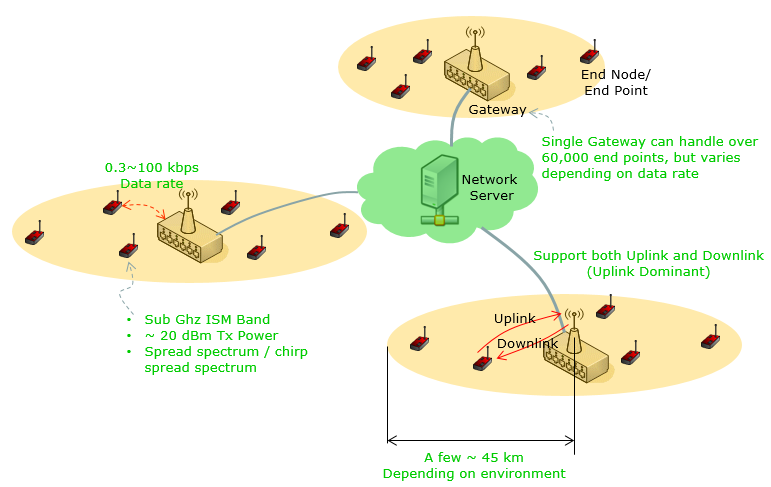
The diagram puts the list above onto a map. Three gateways each serve a cluster of end nodes, and all three connect to one Network Server.
- End Node/End Point : the battery device. It talks only to gateways, never directly to another end node.
- Gateway : the radio side of the network. The notes around it give the radio numbers, a Sub Ghz ISM Band, about 20 dBm Tx power and chirp spread spectrum.
- Network Server : the centre of the network. Every gateway sends the packets it receives to this server.
- Uplink and Downlink : both are supported, but the uplink dominates. The range is a few km up to 45 km, depending on the environment.
Two names are easy to mix up here. LoRa is the radio layer, a chirp spread spectrum modulation from Semtech. LoRaWAN is the MAC and network protocol of the LoRa Alliance that runs on top of it, and it defines the roles in the diagram. A LoRaWAN end node does not attach to one gateway. Every gateway in range receives its uplink and forwards it, and the Network Server removes the duplicates. So a moving node needs no handover.
The data rate range of 0.3 to 100 kbps comes mostly from the spreading factor, SF7 to SF12. A higher spreading factor makes each symbol longer. This lowers the data rate but lets the gateway decode a weaker signal. ADR, Adaptive Data Rate, lets the network choose the spreading factor for each node. A node close to a gateway uses a low spreading factor, so it spends less time on the air and less battery.
LoRaWAN also defines three device classes for the downlink. A Class A device opens two short receive windows after each uplink, and it sleeps the rest of the time. A Class B device adds receive slots at scheduled times. A Class C device listens almost all the time, so it needs a power supply rather than a small battery.
LoRa is the radio, LoRaWAN is the network protocol : the gateways, the Network Server and the device classes belong to LoRaWAN.The spreading factor trades rate for range : ADR picks the lowest spreading factor that still reaches a gateway.Any gateway in range can receive a node : the Network Server removes duplicates, so no handover is needed.Class A is the default for battery devices : the device can receive only right after it sends.
How is a nationwide LoRa network built ?
In Jul 2017, SKT (a Network Operator in South Korea) deployed the nation wide IoT network based on LoRa. The overall network configuration is as follows (This illustration is based on a presentation in Ref [6])
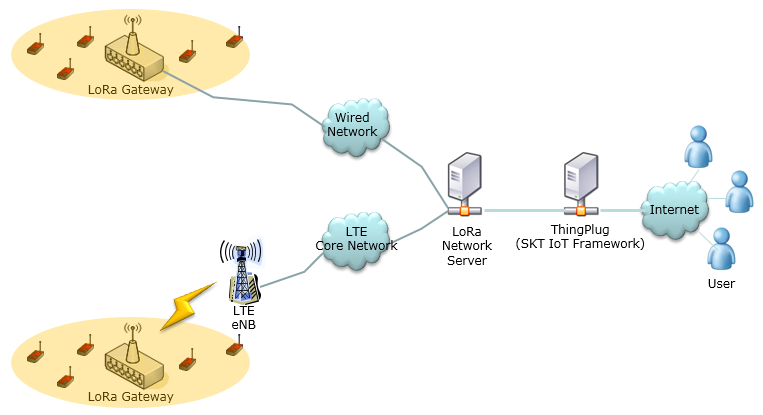
The diagram shows the path of the data from left to right.
- LoRa Gateway : two gateways, each with its own end nodes. They reach the rest of the network in two different ways.
- Wired Network and LTE Core Network : the backhaul. The upper gateway uses a wired line. The lower gateway uses an LTE radio link to an LTE eNB and then the LTE Core Network.
- LoRa Network Server : the same role as in the general architecture above. It collects the packets from all gateways.
- ThingPlug : the SKT IoT Framework. It is the application platform between the LoRa Network Server and the users on the Internet.
The LTE backhaul is the design choice to notice. A LoRa gateway needs an IP connection to the Network Server, and a mobile operator already has LTE coverage almost everywhere. With LTE backhaul, the operator can place a gateway at a site with no wired line. So the operator builds the LoRa coverage on top of its own LTE network.
The platform on the right matters too. A private LoRa network, as the last feature in the list above describes, needs its owner to run everything up to the Network Server. In an operator network, the operator runs the gateways, the Network Server and ThingPlug, and the customer only connects devices and applications.
A gateway needs only an IP backhaul : wired or LTE, the LoRa Network Server sees the same packets.An operator network reuses its LTE coverage : LTE backhaul lets gateways go where no wired line exists.The operator runs the whole chain : the customer brings the end nodes and the application.
Reference
[3] LoRa Specification - 2015 LoRa Alliance, Inc
[4] Talktime: Ronan Schwarz – Internet of Things with LoRa (YouTube)
[5] T Dev Forum. 06 LPWA Technology and Development Trend (YouTube, in Korean)
[6] T dev forum - IoT N/W (LoRa etc) (YouTube, in Korean)
[7] #112 LoRa / LoRaWAN De-Mystified / Tutorial
[8] #115 How to build a LoRa / LoraWAN Gateway and connect it to TTN? Using an IC880a Board
[9] #117 DIY LoRa Node with Arduino and Dragino Shield connected to TTN LoRaWAN
[10] #124 Cheap LoRa Gateway: How to Build with one with Raspberry Pi and Dragino