In CELL_FACH state the UE has no dedicated physical channel. So every downlink logical channel has to travel on a common transport channel. Before Release 7, these are FACH and PCH on the SCCPCH. This page shows one example of that mapping, with the rb-id and the logical channel identity of each channel.
The same mapping holds for Release 99, Release 5 and Release 6. Release 5 and Release 6 add HS-DSCH only in CELL_DCH, and HS-DSCH reception in CELL_FACH arrives with Release 7. The Release 7 version is on the Enhanced Cell FACH R7 page.
- What does the CELL_FACH channel mapping look like?
- How does the UE tell the channels apart on one FACH?
- Reference
What does the CELL_FACH channel mapping look like?
Let's start with the picture, because the next section refers back to it. The question is simple. Which logical channel goes on which transport channel while the UE sits in CELL_FACH?
The diagram below has three rows. The top row lists eight logical channels. Above each box are two labels: the radio bearer identity, rb-id, and the logical channel identity, LCID, used on FACH. The middle row holds the two transport channels, PCH and FACH. Both of them end on one physical channel, the SCCPCH.
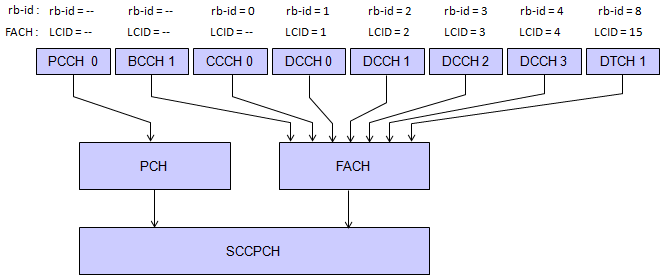
Only PCCH goes to PCH. Every other channel in the diagram, common or dedicated, shares the FACH on the SCCPCH.
PCCH 0 goes to PCH : paging is the only logical channel on PCH. It has no rb-id and no LCID.BCCH 1 and CCCH 0 go to FACH without an LCID : MAC identifies them by the TCTF field, not by a logical channel number.CCCH is SRB0 : its rb-id is 0. RRC Connection Setup reaches the UE on this channel.DCCH 0 to DCCH 3 are SRB1 to SRB4 : they use rb-id 1 to 4 and LCID 1 to 4 on FACH.DTCH 1 is the user plane bearer : it uses rb-id 8 in this example, and LCID 15 on FACH.
The four DCCHs are not four copies of one channel. 25.331 gives each signalling radio bearer its own job. RB1 carries RRC messages in RLC UM. RB2 carries RRC messages in RLC AM. RB3, and optionally RB4, carry the RRC messages that hold NAS signalling. Each of them has its own RLC entity in the UE, so the UE has to know which DCCH a FACH block belongs to.
Release 6 also allows MCCH, MSCH and MTCH on FACH for MBMS, and CTCH on FACH carries cell broadcast. The diagram leaves these channels out, because it shows only the channels of a normal call.
One common transport channel for almost everything : in CELL_FACH, signalling and user data share the FACH.rb-id and LCID are different numbers : DTCH 1 has rb-id 8 but LCID 15 in this example.
How does the UE tell the channels apart on one FACH?
Seven logical channels share one FACH in the diagram above. Every UE in the cell also reads the same FACH. So each MAC PDU needs fields that say which channel and which UE the block belongs to. MAC-c/sh uses the TCTF, C/T and UE-Id fields for this, and the LCID labels in the diagram are the values behind C/T.
The first field is the Target Channel Type Field, TCTF. It sits at the start of every MAC PDU on FACH and gives the class of the logical channel. On FACH for FDD, TCTF 00 means BCCH and 01000000 means CCCH. TCTF 11 means a dedicated channel, DCCH or DTCH. Other TCTF values mark CTCH and the MBMS channels.
The second field is C/T. It appears only on a dedicated channel and gives the logical channel number, from 1 to 15. The C/T value is the LCID minus one, so LCID 1 is coded 0000 and LCID 15 is coded 1110. The value 1111 is reserved. A dedicated PDU on FACH also carries a UE-Id type and a UE-Id, the C-RNTI or the U-RNTI, because FACH is shared by all UEs in the cell.
This explains the labels in the diagram. BCCH and CCCH show LCID = --, because TCTF alone identifies them. PCCH needs no header at all, because PCH carries nothing but paging. The DCCH and DTCH boxes carry real LCID values, because C/T is the only field that separates them.
The network assigns both numbers in the RB mapping info of 25.331. The rb-id names the radio bearer, and the logicalChannelIdentity field sets the LCID. The LCID does not have to equal the rb-id. In this example DCCH 0 to DCCH 3 use LCID = rb-id, but DTCH 1 uses LCID 15 with rb-id 8.
TCTF gives the channel class : BCCH, CCCH, CTCH, an MBMS channel, or a dedicated channel.C/T gives the channel number : LCID 1 to 15, coded as LCID minus one.UE-Id separates the UEs : a dedicated PDU on FACH carries the C-RNTI or the U-RNTI.PCCH on PCH has no MAC header : PCH carries only paging, so nothing needs to be identified.
Reference
[1] 3GPP TS 25.301 v19.0.0 - clause 5.3.1.1.2, Mapping between logical channels and transport channels
[2] 3GPP TS 25.321 v19.0.0 - clause 9.2.1, MAC PDU header parameters: TCTF, C/T and UE-Id
[3] 3GPP TS 25.331 v19.0.1 - clause 6.3, Signalling Radio Bearers