Determining a Resource Allocation type is very tricky since many other parameters get involved. One informative table would help you with this job. As you see here, which Resource Allocation type to be used is determined by several factors like TM, No of CW, DCI format etc. However, you (eNB) may have a couple of choices even with the same condition (i.e, same TM, CW and DCI format) and it is all up to eNB radio stack implementation. For example, if eNB is configured to bet TM1, No of CW = 1 and use DCI format 1, it can use either type 0 or Type 1. Then, which type it will choose ? It is up to eNB decision making algorithm. Once eNB decided to which type it use, it specify the resource allocation type in DCI. If the eNB is set to be TM1, No of CW = 1 and decided to use DCI format 1A, it can only use Type 2.
As another example, if eNB is configured to be TM3 and CW = 2 (MIMO), it must use DCI format 2A, but it has choice of using Type 0 or Type 1. It is also up to eNB decision making algorithm to decide whether it will use type 0 or type 1.
How do you read the mapping table ?
The table is easier to read from the right. Its last column has only three values, and the DCI format beside each row already fixes that value. The columns on the left only decide which DCI formats a UE in that TM is listening for.
The table below lists TM1 to TM7 for a UE addressed by C-RNTI. For each TM it gives the number of codewords, the DCI formats that TM can use, and the resource allocation type each format can carry. A format with two types spans two rows, one for Type 0 and one for Type 1.
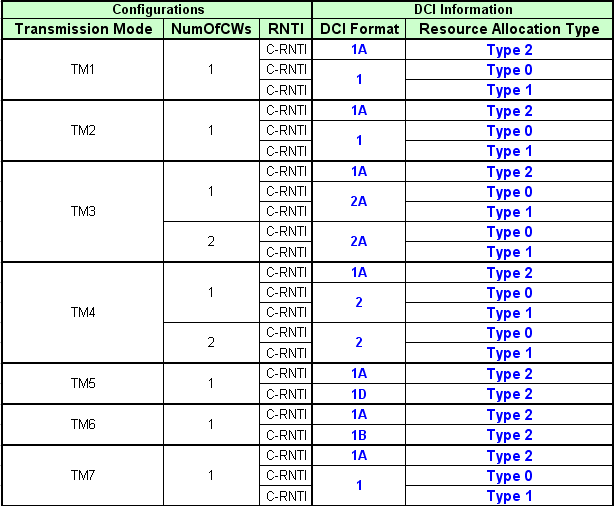
Every TM pairs the fallback format 1A, which is always Type 2, with one format of its own. That second format decides whether the eNB can use a bitmap.
Format 1A appears in every TM : each TM from TM1 to TM7 has a 1A row, and every 1A row gives Type 2.Formats 1, 2 and 2A always come in two rows : one row says Type 0 and the other says Type 1, because the resource allocation header bit chooses between them.TM5 and TM6 have no bitmap at all : their own formats, 1D and 1B, give Type 2 just as 1A does.Two codewords only appear in TM3 and TM4 : those are the only TMs in the table with a two codeword row, and it uses 2A or 2.The RNTI column holds only C-RNTI : the table describes dedicated scheduling of one UE, not broadcast or random access.
The pattern in the table comes from 36.213 Table 7.1-5. Every TM there has DCI format 1A in the common and UE specific search spaces, and one more format in the UE specific search space only. So format 1A is the fallback a UE can always decode, for example while the eNB is reconfiguring its TM.
The resource allocation type then follows from the format and nothing else. 36.213 clause 7.1.6 gives type 2 to formats 1A, 1B, 1C and 1D. It gives type 0 or type 1 to formats 1, 2, 2A, 2B, 2C and 2D. So when you want to know the possible types for a TM, find its two formats and read the type from each.
Notice that the number of codewords does not change the type. TM3 with one codeword and TM3 with two codewords both use format 2A with Type 0 or Type 1. The codeword count changes the precoding instead. 36.212 clause 5.3.3.1.5A says that with 2 antenna ports and format 2A, one codeword means transmit diversity and two codewords mean two layers. With 4 antenna ports, one codeword also allows 2 layer large delay CDD for a retransmission.
Read the DCI format first : the format alone fixes the possible resource allocation types.1A is the fallback in every TM : a UE can always be scheduled with Type 2, whatever its TM.The eNB picks between Type 0 and Type 1 : the specification lets it choose per assignment and signals the choice in the header bit.Codewords change the scheme, not the type : one or two codewords in format 2A still give Type 0 or Type 1.
What happens beyond TM7 and outside C-RNTI ?
The table stops at TM7 and shows only C-RNTI. Later releases added three more TMs, and a UE also decodes DCI scrambled by other RNTIs. The same rule covers all of these cases, so the table extends without surprises.
TM8, TM9 and TM10 follow the TM1 to TM7 pattern. Each of them keeps format 1A as the fallback, and each adds one format of its own. That format is 2B for TM8, 2C for TM9 and 2D for TM10. All three are in the type 0 or type 1 group of 36.213 clause 7.1.6, so these TMs give the same Type 2, Type 0 and Type 1 choice as TM3 or TM4.
Broadcast and random access scheduling is different. 36.213 Tables 7.1-1, 7.1-2 and 7.1-3 cover SI-RNTI, P-RNTI and RA-RNTI, and they allow only format 1C and format 1A, both in the common search space. So SIB, paging and random access response PDSCH are always scheduled with Type 2. Format 1C also always uses distributed VRBs, so the eNB has no localized option there.
Table 7.1-5 in the current release also lists the short TTI formats 7-1A to 7-1G beside the legacy ones. They work differently again. With shortTTI configured, higher layers configure them for type 0 or type 2.
TM8, TM9 and TM10 fit the same pattern : 1A gives Type 2, and 2B, 2C or 2D give Type 0 or Type 1.Common channel scheduling is always Type 2 : SI-RNTI, P-RNTI and RA-RNTI use format 1C or 1A only.Format 1C is always distributed : there is no localized flag in it.Short TTI formats are configured, not signalled : formats 7-1A to 7-1G use type 0 or type 2 as higher layers set.
Reference
Both rules on this page come from 36.213. Table 7.1-5 gives the formats of each TM, and clause 7.1.6 gives the type of each format. The codeword note comes from 36.212.
- [1] 36.213 : 3GPP - E-UTRA; Physical layer procedures, v19.4.0. Tables 7.1-1 to 7.1-5 and clause 7.1.6.
- [2] 36.212 : 3GPP - E-UTRA; Multiplexing and channel coding, v19.3.0. Clause 5.3.3.1.5A defines DCI format 2A.
- [3] Resource Allocation Type : the page that explains Type 0, Type 1 and Type 2 in detail.