As the terminology implies, Physical Cell ID is an indentification of a cell at physical layer. It has similar role as Primary Scrambling Code of UMTS cell.
The PCI is the first identity a UE learns about a cell, before it has decoded a single bit of system information. Almost every downlink and uplink physical signal is derived from it. This page shows where the PCI comes from, how it differs from the Cell ID in SIB1, and which physical processes depend on it.
Followings are the topics to be covered in this page.
- PCI from PSS and SSS
- Physical Cell ID vs Cell ID in SIB1
- Note 2 : Relationship between Physical Cell ID and Cell Specific Reference Signal
- Note 3 : Physical Cell ID and Pseudo-Random Sequence
- Reference
PCI from PSS and SSS
How does a UE find the PCI of a cell it has never seen? The PCI is not broadcast as a number in any message. It is encoded in the choice of the two synchronization sequences, so the UE finds it while it searches for timing.
This physical cell ID is determined by Primary Sync Signal and Secondary Sync Signal as described below.
The picture below sums up the rule in four lines. The PSS gives the cell number, the SSS gives the cell group number, and the two combine into the Cell ID.
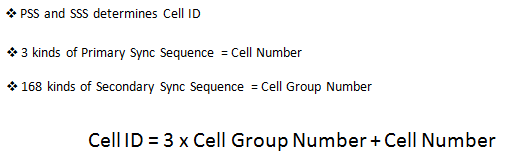
The PCI is built from the PSS, which has 3 values, and the SSS, which has 168 values.
36.211 v19.3.0 clause 6.11 states the same rule with its own names. NIDcell = 3 NID(1) + NID(2). Here NID(1) is the physical-layer cell-identity group from 0 to 167, carried by the SSS. NID(2) is the identity within the group from 0 to 2, carried by the PSS. That gives 3 x 168 = 504 unique PCIs, from 0 to 503.
The UE decodes the two parts in that order. It first correlates against the three PSS sequences, which are Zadoff-Chu sequences with roots 25, 29 and 34 for NID(2) = 0, 1 and 2. That gives NID(2) and the 5 ms timing. It then tests the 168 SSS sequences, which gives NID(1) and the frame boundary. The PSS and SSS pages show both sequences in detail.
Refer to Cell ID Detection ans System Information Detection to know specifically how this physical cell is used in the process of initial cell detection.
PCI = 3 x group + identity in the group : 36.211 clause 6.11.504 PCIs, 0 to 503 : 168 groups of 3.PSS gives the identity in the group : SSS gives the group.
Physical Cell ID vs Cell ID in SIB1
A cell carries two identities, and they are easy to mix up. The PCI serves the physical layer, and the Cell ID in SIB1 serves the network. The note below, and the paragraph after it, describe the difference.
Note 1: There are another type of cell ID which is carried by SIB1(systeminformationBlockType1.cellAccessRelatedInfo .cellIdentity). When we say just 'Cell ID', it normally refers to the cell ID carried by SIB1 but many people (including myself -:) get confused with 'cell id' and 'physical cell id'.
Physical Cell ID is mainly used by UE to decode physical layer data being transmitted by eNodeB. Cell ID in SIB1 is designed for eNodeB management within the core network, but this one is also used for UE to identify a specific cell in terms of RRC/NAS layer processing.
The two identities differ in size, as the definitions below show. PhysCellId is an integer from 0 to 503, while CellIdentity is a 28-bit string.
Following is based on
PhysCellId ::=                      INTEGER (0..503)

                CellIdentity ::=                    BIT STRING (SIZE (28))
With only 504 values, PCIs must be reused across a network, so two distant cells often share one. The 28-bit CellIdentity is unique within a PLMN. It holds the eNB ID, 20 bits for a macro eNB, and an 8-bit cell number within that eNB. With the PLMN identity in front, it becomes the E-UTRAN Cell Global Identifier, or ECGI, which is unique worldwide.
This split has a practical effect. A measurement report identifies a neighbour cell only by its PCI and carrier. The eNB may not know which cell a PCI belongs to. It can then ask the UE to read the SIB1 of that cell and report its CGI, which resolves the ambiguity.
PhysCellId: 0 to 503 : reused across the network.CellIdentity: 28 bits : eNB ID plus cell number, unique in the PLMN.Measurement reports carry the PCI : the CGI report resolves ambiguity.
Note 2 : Relationship between Physical Cell ID and Cell Specific Reference Signal
The resource element locations for Cell Specific Reference signal is influenced by Physical Cell ID(see NOTE2 of Reference Signal - Downlink for details). In case all other variables are the same, there can be conditions where the resource element for the reference signal is same even when the physical cell ID is different if any two Physical Cell IDs (let's call them PCI1 and PCI2) meets the following condition.
PCI1 mod 6 == PCI2 mod 6
If these values are same and the reference signal from two cells may interfere each other and UE would have difficulties detecting cell.
It means that you should be carefull when you are allocating Physical Cell IDs in eNodeB deployment or when you assign physical cell IDs for multiple cells on Network Simulator (UE test equipment).
The rule behind the note is the cell-specific frequency shift of 36.211 v19.3.0 clause 6.10.1.2, vshift = NIDcell mod 6. With one antenna port, the CRS sits on every 6th subcarrier, starting at vshift. So two cells with the same PCI mod 6 put their CRS on the same REs, as the note says. The Reference Signal - Downlink page shows the CRS grid for each shift.
With 2 or 4 antenna ports, the collision rule becomes stricter. Port 1 uses the subcarriers 3 away from port 0, so the CRS of ports 0 and 1 together repeat every 3 subcarriers. Two cells with the same PCI mod 3 then have CRS on the same REs. The same value, PCI mod 3, is also NID(2), so those two cells also send the same PSS. This is why network planning usually avoids equal PCI mod 3 between neighbours.
Other processes use other functions of the PCI. The table below lists the common ones, so the planning rules can be read from one place.
Function of the PCI | What it sets | 36.211 v19.3.0 |
PCI mod 3 | PSS sequence, and CRS REs with 2 or 4 ports | 6.11.1, 6.10.1.2 |
PCI mod 6 | CRS REs with 1 port | 6.10.1.2 |
PCI mod 2NRB | PCFICH REG positions | 6.7.4 |
PCI mod 30 | PUCCH sequence group, and PUSCH with Deltass added | 5.5.1.3 |
PCI | Scrambling of PBCH, PCFICH, PDCCH, PHICH and PDSCH, and the CRS sequence | 6.3.1, 6.10.1.1 |
The PCFICH row is described on the PCFICH page. Besides these rules, planning also avoids PCI collision, where two neighbours share a PCI, and PCI confusion, where one cell has two neighbours with the same PCI.
vshift = PCI mod 6 : CRS position with one port.With 2 or 4 ports, PCI mod 3 matters : and it also sets the PSS.PCI mod 30 : uplink DMRS sequence group.
Note 3 : Physical Cell ID and Pseudo-Random Sequence
Most of downlink signal and data is scrambled by a specific Pseudo-Random Sequence and PCI is involved in the initialization of the pseudo random sequence generation algorithm. Due to this random sequence, even when exactly same data is transmitted from higher layer, the physical data turns into a unique sequence for each eNB. Refer to Pseudo-Random Sequence page for the details.
The PCI enters the initial value cinit of the Gold sequence of 36.211 v19.3.0 clause 7.2. For the PBCH, cinit is the PCI itself, so the scrambling depends on nothing else. For the PDSCH, cinit = nRNTI x 214 + q x 213 + floor(ns/2) x 29 + NIDcell, which adds the RNTI, the codeword q and the subframe. The PCFICH, PDCCH and PHICH also combine the PCI with the subframe number, and the CRS sequence combines it with the slot and the symbol.
The effect is that a UE cannot descramble anything from a cell until it knows that cell's PCI. It also means that interference from a neighbour cell looks like noise rather than like a valid signal, because it was scrambled with a different sequence. This randomisation is one of the reasons LTE can reuse the same carrier in every cell.
PBCH: cinit = PCI : 36.211 clause 6.6.1.PDSCH: RNTI, codeword, subframe and PCI : 36.211 clause 6.3.1.Different PCI, different scrambling : neighbour interference looks like noise.
Reference
[1] 3GPP TS 36.211 v19.3.0 - clause 6.11, Synchronization signals; clause 6.10.1, Cell-specific reference signals; clause 7.2, Pseudo-random sequence generation
[2] 3GPP TS 36.331 v19.3.0 - PhysCellId and CellIdentity