You would know of SC-OFDM because this is the waveform that we use in current LTE. If you are familiar with SC-FDMA, you can easily understand DFT-s-OFDM(Discrete Fourier Transform spread Orthogonal Frequency Division Multiplexing) . High level view of DFT-s-OFDM waveform generation is illustrated as follows. You would notice that this is almost same as high level SC-OFDM process.
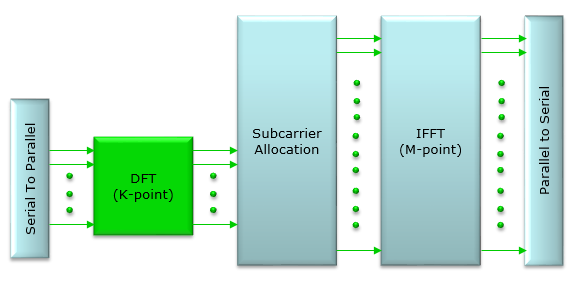
Below is the breakdown and brief description of each of the blocks
-
Serial to Parallel Conversion:
-
The input data stream (usually modulated symbols such as QPSK, 16-QAM, or 64-QAM) is split into multiple parallel streams.
-
This step organizes the data to be processed simultaneously.
-
DFT (K-point):
-
A K-point Discrete Fourier Transform is applied to the input symbols.
-
This step spreads the input symbols across the frequency domain.
-
This operation is what gives DFT-s-OFDM its "single-carrier-like" properties because it creates a frequency-domain representation of the signal while retaining low PAPR characteristics.
-
Subcarrier Allocation:
-
The DFT output is mapped onto a subset of the available subcarriers in the frequency domain.
-
The unused subcarriers remain empty (zero-padding) to fit the desired bandwidth and avoid interference.
-
This ensures efficient spectral usage and helps in uplink resource allocation.
-
IFFT (M-point):
-
An Inverse Fast Fourier Transform (IFFT) is applied to the mapped subcarriers, converting the signal back to the time domain.
-
This creates the OFDM waveform that is transmitted over the air.
-
Here, M is typically larger than K, as only a subset of the subcarriers are occupied.
-
Parallel to Serial Conversion:
-
The parallel time-domain samples are converted back into a single serial data stream for transmission.
Key Characteristics of DFT-s-OFDM:
DFT-s-OFDM combines the benefits of both single-carrier and multi-carrier techniques. This hybrid approach leverages the efficiency and flexibility of OFDM while addressing its limitations, such as high Peak-to-Average Power Ratio (PAPR), through the integration of a Discrete Fourier Transform (DFT) step. By preserving single-carrier-like characteristics and enabling efficient resource allocation, DFT-s-OFDM ensures optimal performance in power-constrained mobile devices. Additionally, its inherent robustness to multipath fading makes it well-suited for maintaining reliable communication in diverse and dynamic wireless environments.
-
Low PAPR:
-
Compared to standard OFDM, DFT-s-OFDM has a lower Peak-to-Average Power Ratio, which is crucial for efficient power amplifier operation in the uplink.
-
Single-Carrier-like Behavior:
-
The DFT step introduces frequency-domain spreading, making the transmitted signal behave similarly to single-carrier transmission, which is beneficial for uplink transmission where mobile devices have limited power.
-
Efficient Resource Utilization:
-
The subcarrier allocation step allows flexible and efficient assignment of frequency resources, making DFT-s-OFDM ideal for LTE’s uplink scheduling.
-
Robustness to Multipath:
-
Like standard OFDM, DFT-s-OFDM provides robustness against multipath fading, as the IFFT converts the signal to the time domain while maintaining orthogonality between subcarriers.
Reference
[1] Frequency-Domain Equalization and Single-Carrier Transmission in OFDM Framework by Markku Renfors