|
|
||
|
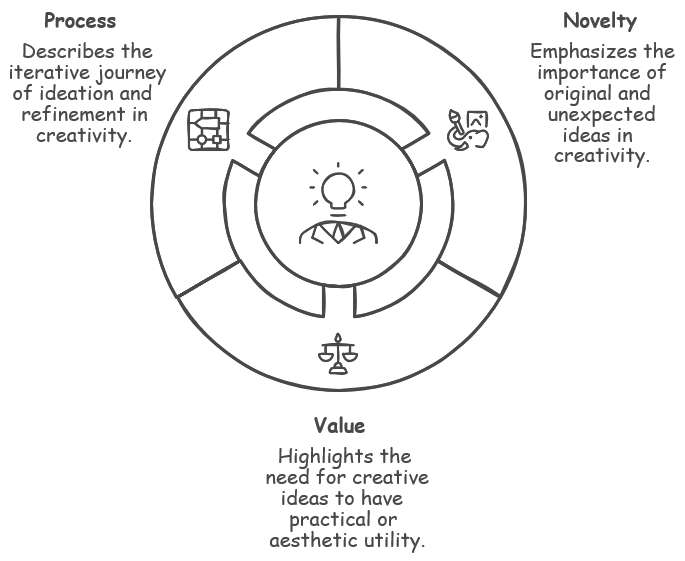
Creativity is a complex and multifaceted concept, not limited to a single definition or aspect. It encompasses the remarkable human capacity to generate innovative and valuable ideas, discover effective solutions, and produce captivating artistic expressions. At its core, creativity involves transcending conventional thinking patterns, venturing beyond the confines of established norms and limitations, and embracing a mindset that fosters originality and ingenuity. One of the hallmarks of creativity is the ability to think outside the box, to challenge assumptions and explore uncharted territories of thought. Creative individuals possess a unique ability to forge connections between seemingly disparate concepts, recognizing hidden patterns and relationships that others might overlook. This capacity for divergent thinking enables them to approach problems from multiple angles, consider alternative perspectives, and ultimately arrive at novel and often unexpected solutions. Creativity is not merely a mental exercise; it is a dynamic process that involves both cognitive and emotional engagement. It requires a willingness to experiment, to take risks, and to embrace uncertainty. Creative individuals are often driven by a deep sense of curiosity and a passion for exploration, constantly seeking new challenges and opportunities for growth. In essence, creativity is a transformative force that fuels innovation, drives progress, and enriches our lives in countless ways. It is a fundamental human trait that enables us to adapt to a constantly changing world, overcome obstacles, and express ourselves in unique and meaningful ways. Whether it manifests in the realm of art, science, technology, or everyday life, creativity is a powerful catalyst for change and a source of boundless potential. Key aspects of creativityCreativity is a dynamic and multifaceted human capacity that drives innovation, problem-solving, and artistic expression. It is the ability to generate novel ideas, forge connections between seemingly unrelated concepts, and approach challenges with a fresh perspective. While often associated with artistic endeavors, creativity is not confined to any particular domain; it permeates all aspects of human life, from scientific discovery to everyday problem-solving. Creativity has a few key aspects as follows
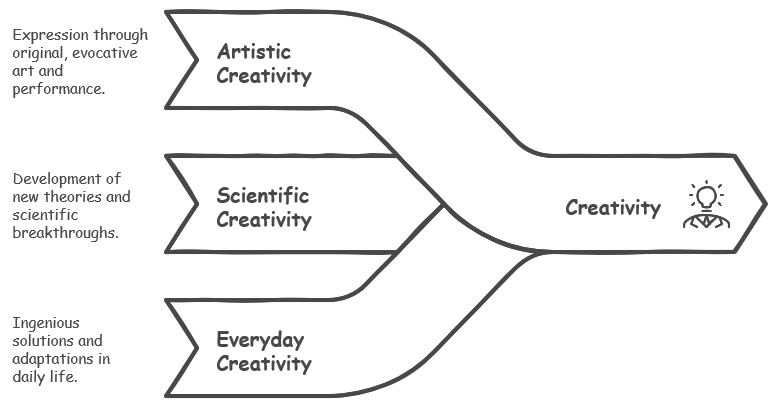
Types of CreativityCreativity is not a monolithic concept, but rather manifests in diverse forms across various domains of human endeavor. While the essence of creativity remains consistent—the generation of novel and valuable ideas—the specific expressions and applications vary widely. Here are some notable types of creativity:
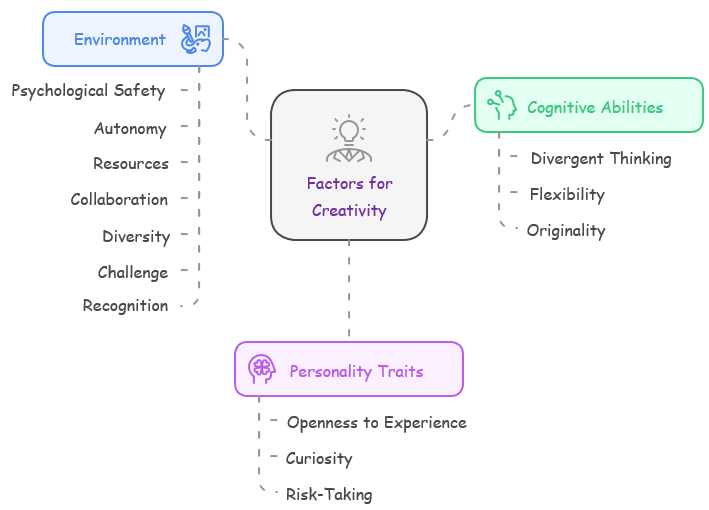
Factors for CreativityCreativity is a complex phenomenon influenced by a multitude of factors, both internal and external. While some individuals may possess a natural inclination towards creative thinking, research suggests that creativity can be nurtured and enhanced through a combination of cognitive abilities, personality traits, and environmental conditions.
Factors that contribute to creativity include: Cognitive Abilities:Cognitive abilities play a crucial role in shaping and enhancing our creative potential. These mental processes enable us to think beyond conventional boundaries, explore diverse possibilities, and generate novel ideas that contribute to innovation and problem-solving. One such cognitive ability is divergent thinking, which refers to the capacity to generate a multitude of ideas, solutions, or perspectives in response to a given challenge. Divergent thinkers possess a unique ability to break free from linear thinking patterns and explore a vast landscape of possibilities, often leading to unexpected and groundbreaking solutions. They are not limited by preconceived notions or conventional wisdom, but instead, embrace a mindset of open-ended exploration and experimentation. Flexibility is another cognitive trait that plays a pivotal role in creative thinking. It involves the ability to adapt to new situations, shift perspectives, and consider alternative approaches when faced with obstacles or setbacks. Flexible thinkers are not rigidly attached to a single solution or viewpoint; they are open to change and willing to explore different paths to achieve their goals. This adaptability enables them to navigate complex problems with agility and resilience, ultimately leading to more creative and effective solutions. Originality is a hallmark of creative thinking, characterized by the capacity to produce unique, unconventional, and surprising ideas. Original thinkers are not content with simply following established norms or replicating existing solutions. They possess a drive to challenge the status quo, question assumptions, and forge their own path. This unwavering commitment to originality often leads to groundbreaking innovations, artistic masterpieces, and scientific breakthroughs that redefine our understanding of the world.
Personality Traits:Certain personality traits have been linked to enhanced creativity and a greater capacity for innovative thinking. One such trait is openness to experience, which is characterized by a willingness to embrace new experiences, ideas, and perspectives. Individuals who are open to experience tend to be curious, imaginative, and receptive to novelty, making them more likely to engage in creative pursuits and explore uncharted territories of thought. This openness allows them to see connections between seemingly disparate ideas, challenge assumptions, and generate unique solutions to complex problems. Curiosity, another personality trait closely associated with creativity, is defined by a strong desire to learn, explore, and understand the world around us. Curious individuals possess an insatiable thirst for knowledge and a passion for discovery, fueling their creative endeavors. They are constantly seeking new information, asking questions, and challenging themselves to delve deeper into subjects that pique their interest. This relentless pursuit of knowledge allows them to make connections between seemingly unrelated concepts, leading to innovative solutions and creative breakthroughs. Risk-taking is a personality trait that is often essential for creative expression. Individuals who are willing to take risks are not afraid to step outside their comfort zones, challenge conventional wisdom, and embrace uncertainty. They understand that failure is an inevitable part of the creative process and view setbacks as opportunities for learning and growth. This willingness to experiment and embrace the unknown allows them to push boundaries, explore new possibilities, and ultimately achieve greater creative success.
Environment:The environment in which individuals operate plays a pivotal role in shaping their creative potential. A supportive and stimulating environment serves as a fertile ground for cultivating creativity, fostering an atmosphere where individuals feel empowered to experiment, take risks, and explore novel ideas without fear of judgment or reprisal. Such an environment is characterized by a culture of openness, where diverse perspectives are valued and collaboration is encouraged. It provides individuals with the necessary resources, support, and freedom to pursue their creative passions, allowing them to flourish and reach their full potential. A supportive and stimulating environment that fosters creativity typically includes the following elements:
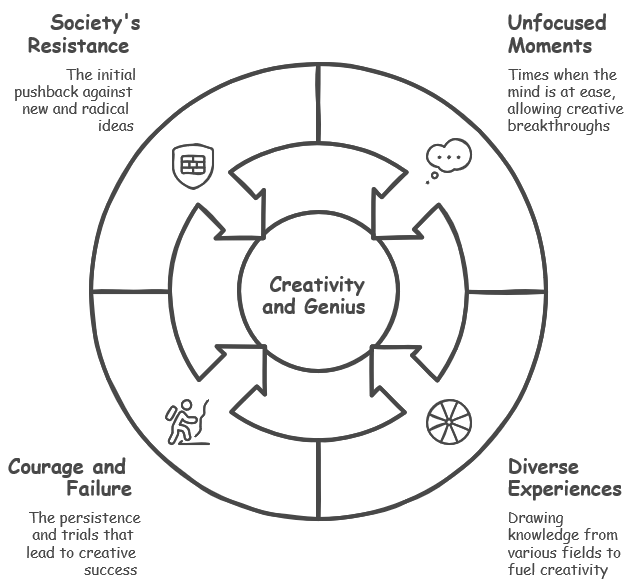
How Creativity Sparks GeniusGenius isn’t just raw intellect - it’s creativity in action. Science suggests that the most brilliant minds are fueled by a chaotic, imaginative spark, blending wild contradictions into something extraordinary. These creative souls don’t fit neat boxes; their thinking thrives on complexity, weaving unexpected patterns from the clutter of ideas. Creativity often blooms when the mind wanders free. Some of history’s most ingenious concepts - a haunting tune, a game-changing invention, a bold vision - sprang up during a quiet stroll, a steamy shower, or that hazy moment after sleep. It’s in these unscripted pauses that the unconscious takes over, playfully stitching together fragments of experience into bursts of originality. The more diverse the mental palette - art brushing against science, or curiosity crossing disciplines - the richer the canvas for creative leaps, yielding marvels that redefine what’s possible. At its core, creativity isn’t a fleeting “aha”—it’s a vibrant, messy dance of persistence and imagination. So, next time you’re stuck, let your thoughts roam. That detour might just ignite the genius within.
Creativity as a “Messy Mind”What does it mean to have a creative mind? Psychologists exploring the brilliance of geniuses in art, science, leadership, and the humanities have uncovered a fascinating truth: highly creative people don’t follow a single, predictable pattern. Instead, their minds dance between multiple contradictory or even extreme qualities simultaneously - a phenomenon one researcher has dubbed “complexity.” This messy, dynamic interplay might just be the secret behind their genius.
Importance of “Unfocused” MomentsCreative breakthroughs don’t always strike during intense focus - hey often sneak in when the mind is at ease, drifting through a shower, a leisurely walk, or the hazy edge of a dream. Science suggests these unfocused moments are key because the unconscious mind works its magic best when unrestrained, weaving together past experiences and knowledge with a freedom that conscious effort can’t replicate. It’s in this quiet wandering that brilliance often takes root.
The Power of Diverse ExperiencesGenius thrives on variety, not confinement to a single lane. Creative minds pull from a rich tapestry of skills and interests, gathering insights across disciplines to fuel their imagination. This blend of knowledge acts like raw materials, giving the unconscious mind plenty to play with as it forges fresh connections - think of how one polymath’s fusion of anatomy, mathematics, and art sparked a masterpiece that still captivates the world. It’s this diversity that powers the creative engine.
Society’s Resistance to New IdeasNew ideas often hit a wall of resistance. History shows that bold thinkers - whether pushing for hygiene in medicine or bending musical rules - faced mockery or dismissal before their brilliance was embraced. This pushback stems from a quiet human habit: we tend to unconsciously cling to familiar group norms, making radical creativity a tough sell at first. It’s a reminder that the path to innovation is rarely welcomed with open arms.
Need for Courage and Repeated FailureCreativity isn’t for the faint-hearted - it often means defying the norm, a bold stand that demands conviction amid skepticism. Even the most revered minds churned out flops alongside their triumphs, proving that brilliance isn’t a straight shot. True creative work is a gritty cycle of trial, error, and stubborn perseverance, where each stumble fuels the next spark. It’s this courage to keep going that turns ideas into genius.
Creativity as a Process, Not a Single MomentCreativity isn’t a lightning strike - t’s a slow burn, built through steady action, fearless exploration, and a willingness to flop. Far from a single “eureka,” it’s a process that unfolds over time, often unnoticed until it sticks. Society tends to cheer these bursts of genius only after they’ve settled into acceptance, a nod to how the real magic lies in the persistent-contrib work of persistence piling up beneath. Let your mind wander - hat’s where the next idea might take root.
Reference
YouTube/Other Video
|
||