The world of 5G is expanding beyond our wildest expectations, reaching for the skies and beyond with Non-Terrestrial Networks (NTNs). Imagine a world where even the most remote corners of the Earth, from the depths of dense forests to the vast expanse of the open ocean, are seamlessly connected. NTNs are making this a reality, utilizing satellites and airborne platforms to bridge the connectivity gap and bring the power of 5G to previously unreachable areas. This technology is not just about expanding coverage; it's about revolutionizing industries, enabling innovation, and ensuring that everyone, everywhere can benefit from the transformative power of 5G. So buckle up and prepare to explore the exciting realm of NTNs, where the sky is no longer the limit!
The motivation is obvious as well. If it is realized as expected, it would be able to deliver the 5G service to those places where it is technically very difficult or cost too much to deliver with terrestrial network. Some examples of those places would be a remote area like deep forest that would be too costly with terestrial delivery, or far islands or ship that would be technically almost forbidden in terrestrial connection.
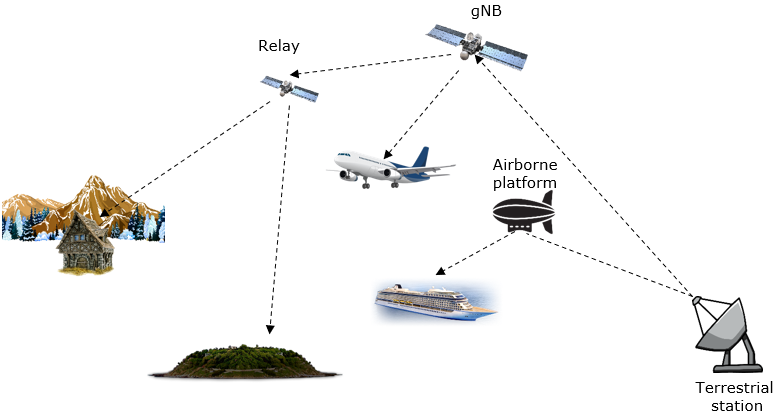
NOTE : The illustration shown above is consolidated representation of various deployment options described in various TRs in the reference section. If you want to get a little bit detailed diagram for each of the deployment plan separately, you may refer to 3GPP TR 38.821 V16.1.0
I found another well summarized illustration from this paper as shown below. It shows various different use cases and potential ground-to-airborne connection mechansm.

There would be no single clear-cut advantage (motivation) of adopting NTN over the existing (conventional) method. Just for brain storming purpose I will just list up all the possible idea that I can collect. Definately there would be more.. and something you don't agree
- Motivations - the Brainstorming List
- The Coverage Argument, in Numbers
- Why 3GPP NTN Rather Than Classic Satellite ?
- What Actually Shipped First
- Where NTN Does Not Make Sense
Motivations - the Brainstorming List
What follows is the unfiltered collection referred to above. It is grouped loosely rather than strictly, so some of the same ideas appear under more than one heading - resilience and redundancy in particular are argued twice from slightly different angles. That is the nature of a brainstorm and it has been left as it is. The sections after the list take the strongest of these arguments and put numbers behind them.
Bridging the Connectivity Gap:
This is the original and still the strongest argument for NTN. It is not about serving people better, but about serving people at all - places where the terrestrial business case has never closed because the cost is dominated by roads, power and backhaul rather than by radio equipment.
Remote Areas : As the image depicts, places like dense forests, mountainous regions, and deserts are often too costly or challenging to cover with terrestrial infrastructure. NTNs, using satellites or airborne platforms, can overcome these geographical barriers and bring essential communication services to underserved populations.Maritime Coverage : Ships at sea often face limited and expensive connectivity options. NTNs can provide reliable and high-speed internet access, enhancing safety, communication, and operational efficiency for maritime industries.Disaster Relief : In the aftermath of natural disasters, terrestrial networks can be damaged or destroyed. NTNs can play a vital role in providing emergency communication and supporting relief efforts.
Enhanced Network Resilience:
A different argument from coverage : here the terrestrial network exists but has stopped working. A satellite is immune to the things that take a ground network down - flooding, fire, an earthquake severing fibre - simply because none of its infrastructure is in the affected area.
Disaster Preparedness : Satellite networks are inherently more resilient to terrestrial disasters like earthquakes, floods, and hurricanes, ensuring communication services remain operational during emergencies.Network Redundancy : Integrating satellites into the cellular network architecture provides an alternative communication path, mitigating the impact of terrestrial network outages and ensuring service continuity.Enhanced Reliability : By leveraging both terrestrial and satellite components, NTNs create a more robust and reliable communication system that can withstand various disruptions.Backup and Redundancy : NTNs can serve as a backup to terrestrial networks in case of outages or disruptions, ensuring continuity of critical services.Network Flexibility : The ability to deploy airborne platforms like balloons or drones allows for rapid network expansion or temporary coverage for specific events or situations.
Expanding the 5G Ecosystem:
Rather than a use case in itself, this is an argument about completeness. Once coverage is continuous across land, sea and air, applications become possible that nobody would design while coverage was patchy, because an application that only works some of the time is usually not worth building.
Ubiquitous Coverage : NTNs contribute to the vision of ubiquitous 5G coverage, enabling seamless connectivity across land, sea, and air.New Use Cases : This expansion opens doors to innovative applications like remote healthcare, precision agriculture, and environmental monitoring in areas previously beyond the reach of cellular networks
Wider Ecosystem
A restatement of the coverage and integration themes from a network operator's point of view rather than a user's. The item worth watching here is Capacity Boost, which is the one claim on this page the arithmetic does not really support - see Where NTN Does Not Make Sense.
Extended Coverage : Satellites can reach areas where terrestrial networks are absent, such as remote rural communities, oceans, and disaster zones, expanding the overall reach of 5G.Capacity Boost : In densely populated areas, satellites can supplement terrestrial networks by providing additional capacity to handle peak demand and ensure consistent service quality.Integrated Network : New protocols and technologies are being developed to seamlessly integrate satellite connectivity within the cellular ecosystem, enabling efficient communication between terrestrial and non-terrestrial components.
Resiliency
This group repeats the three points made under Enhanced Network Resilience above almost word for word. Both have been kept because that repetition is itself telling - resilience is the argument that surfaces most persistently when brainstorming NTN, and it is the one operators tend to reach for first after any large outage.
Disaster Preparedness : Satellite networks are inherently more resilient to terrestrial disasters like earthquakes, floods, and hurricanes, ensuring communication services remain operational during emergencies.Network Redundancy : Integrating satellites into the cellular network architecture provides an alternative communication path, mitigating the impact of terrestrial network outages and ensuring service continuity.Enhanced Reliability : By leveraging both terrestrial and satellite components, NTNs create a more robust and reliable communication system that can withstand various disruptions.
Seamless Roaming/Handover
The argument here is that the transition between terrestrial and satellite coverage should be invisible. That is only achievable because both sides speak the same protocol - which is precisely the payoff of standardising satellite access inside 3GPP rather than alongside it.
Low-Latency Satellites : Advancements in Low Earth Orbit (LEO) satellite technology are significantly reducing latency, enabling near real-time communication that is comparable to terrestrial networks.Optimized Protocols : Cellular protocols are being optimized to facilitate smooth and seamless roaming and handovers between terrestrial and satellite networks, ensuring uninterrupted connectivity for users on the move.Unified User Experience : This seamless transition between networks allows users to stay connected without experiencing disruptions or needing to manually switch between networks.
Better Fit for UE Mobility
Cellular protocols were built from the beginning around a device that moves and changes cell, which is exactly the behaviour an NTN link demands. Classic satellite systems assumed a terminal that stays put and points at one spacecraft, so mobility had to be added to them; in 3GPP it was already there.
Mobile-First Design : Cellular protocols are inherently designed to support users on the move, making them a natural fit for integrating satellite connectivity into the mobile ecosystem.Ubiquitous Access : NTN allows mobile users to access satellite networks as just another node in the cellular network, enabling connectivity regardless of their location or mode of transportation (land, sea, or air).Enhanced Mobility : This seamless integration of satellite connectivity enhances mobility and enables new use cases for connected vehicles, aircraft, and ships.
Cost
The least glamorous group and arguably the decisive one. Almost every advantage listed here comes from volume rather than from technology - once satellite access rides on handset chipsets and an existing core network, it inherits the mobile industry's cost curve instead of the satellite industry's.
Economies of Scale : Leveraging existing cellular architecture and protocols allows NTN to benefit from the economies of scale of the mobile industry, reducing infrastructure and operational costs.Efficient Resource Utilization : By integrating with terrestrial networks, NTNs can optimize resource allocation and reduce the need for dedicated, proprietary satellite infrastructure.Reduced User Costs : The cost-effectiveness of NTN deployment can translate into more affordable service plans for users, especially in areas where terrestrial connectivity is expensive or unavailable.
The Coverage Argument, in Numbers
Almost every item in the list above is a variation on one theme : NTN covers area that terrestrial infrastructure cannot economically reach. That argument is usually made qualitatively, and it is far more convincing with numbers attached - because the numbers are enormous, and because they also expose the exact price you pay for it.
Take an optimistic rural terrestrial macro cell with a 30 km radius. A hexagonal cell of that radius covers about 2,300 km2. Now compare that with the beam footprints from the 3GPP reference scenarios - up to 1,000 km edge to edge for LEO and up to 3,500 km for GEO - using Australia at roughly 7.7 million km2 as a yardstick.
|
Approach |
Area covered by one cell / beam |
Needed to blanket 7.7 million km2 |
|---|---|---|
|
Terrestrial macro, 30 km radius |
approx. 2,300 km2 |
|
|
LEO beam, 1,000 km footprint |
approx. 785,000 km2 |
|
|
GEO beam, 3,500 km footprint |
approx. 9.6 million km2 |
|
That is the whole coverage argument in one table, and it explains why the economics are not close. Three thousand rural sites is not merely expensive - in a desert, a rainforest or an ocean it is not buildable at all, because the cost is dominated by the road, the power line and the backhaul rather than by the radio. A satellite beam needs none of those things over the area it serves.
The same table read the other way is equally instructive. A terrestrial network
-
Terrestrial : 100 MHz re-used across 2,300 km2 per site is on the order of 40,000 Hz of spectrum per km2.
-
GEO : the 2 x 20 MHz of the S band deployment scenario spread over 9.6 million km2 is about 2 Hz of spectrum per km2.
That is a gap of roughly
Why 3GPP NTN Rather Than Classic Satellite ?
There is a second question hiding inside 'Why NTN ?' that the list above touches on but does not state directly. Satellite communication has existed for decades. Inmarsat, Iridium, VSAT and others have served ships, aircraft and remote sites for a very long time. So the interesting question is not why connect via satellite - it is
|
Classic satellite communication |
3GPP NTN |
|
|---|---|---|
|
Device |
A dedicated satellite terminal, bought and carried separately |
|
|
Subscription and billing |
A separate contract with a satellite operator |
The same operator, the same SIM, the same bill - NTN appears as another access to the same 5G core |
|
Moving between networks |
A manual switch to a different device or mode |
Cell reselection and handover, using mechanisms the protocol already has |
|
Security and identity |
System-specific |
The 5G authentication and key agreement framework, unchanged |
|
Chipset economics |
Low volume, so high unit cost |
|
|
Who deploys it |
A satellite operator, competing with mobile operators |
Mobile operators, extending their own coverage - which changes it from a competitor into a product line |
Reading down the right-hand column, notice how little of it is about the radio. Almost every advantage is about
This also explains why the specification work looks the way it does. Very little of Rel-17 NTN invents new radio technology. Almost all of it is adaptation - offsets, timers, validity durations and pre-compensation - whose purpose is to let the existing NR design survive at satellite distances. Keeping it recognisably NR is the entire point, because that is where the value is. See NTN Architecture and NTN Timing Advance.
What Actually Shipped First
It is worth comparing the motivations above against what commercial NTN actually started doing, because the order surprised almost everyone - including, in fairness, the way this page was originally written.
The list above leads with broadband-flavoured arguments : covering remote areas, maritime connectivity, capacity boost, seamless high-speed roaming. What launched commercially first was none of those. It was
In hindsight the reason is the capacity and link budget arithmetic from the previous sections. Serving a handheld with a 0 dBi antenna and 200 mW of transmit power from hundreds of kilometres away is at the edge of what physics permits, and a beam covering a continent has very little spectrum per km2 to divide up. Both constraints point at the same answer : start with the service that needs the fewest bits.
-
Messaging and emergency alerting needs a handful of bytes, tolerates minutes of latency, and is worth a great deal to the person sending it. It is close to the perfect fit for what NTN can actually deliver.
-
IoT-NTN is the same insight applied to machines - a sensor on a pipeline or a container at sea sends a few bytes occasionally and does not care when they arrive.
-
Broadband to remote areas, the argument this page opens with, is real but arrives through directive VSAT terminals in Ka band rather than through handsets - which is a different product with different economics, and is the reason the reference scenarios pair Ka band with relay terminals and S band with handsets.
The useful lesson is that the strongest motivation for NTN turned out not to be more capacity somewhere new, but
Where NTN Does Not Make Sense
A page arguing for something is more useful if it also marks the boundary. NTN is a poor answer to several problems, and knowing which ones prevents a lot of wasted effort.
-
Dense urban capacity : this is the direct consequence of the four-orders-of-magnitude gap. A city is exactly where terrestrial re-use wins hardest. The Capacity Boost bullet in the list above is the weakest item on the page for this reason - supplementing a dense terrestrial network from orbit is not something the arithmetic supports. -
Indoor coverage : building penetration loss on top of a satellite link budget that is already marginal outdoors. Notice that of all the deployment scenarios in TR 38.811, only the HAPS row at around 20 km altitude claims indoor coverage at all. Satellites are outdoor propositions. -
Low latency applications : a GEO round trip of over half a second rules out anything interactive. LEO is far better at around 25 ms, but that is still a floor imposed by geometry, and it is on top of whatever the terrestrial path adds afterwards. -
High volume data at low cost per bit : the scarce resource in orbit is spectrum-per-area and power, both of which are expensive. Anywhere a fibre or a terrestrial cell already reaches, it will deliver bits more cheaply.
None of this weakens the case made above. It sharpens it. NTN is not a better network - it is a network that exists where the better one does not, which is a completely different and much more defensible claim.
Related Pages on this Site
- NTN - What is it ? - the overview, and collected demonstration links
- NTN Challenges - the counterweight to this page
- NTN Architecture - payload types, orbits and deployment scenarios
- NTN Requirement - the data rates and delays actually targeted
- NTN Spectrum - why terminal type decides the band
- NTN Timing Advance - how the distance is made survivable
- NTN Frequency Compensation - how the motion is made survivable
3GPP Reference
- Non-Terrestrial Networks (NTN) - 3GPP Technology Article (2024)
- 3GPP TR 38.811 : Study on New Radio (NR) to support non-terrestrial networks - deployment scenarios and beam footprint sizes
- 3GPP TR 38.821 : Solutions for NR to support non-terrestrial networks (NTN) - reference scenarios and their parameters
- 3GPP TS 22.261 : Service requirements for the 5G system - where the service-level motivation is written down normatively
- 3GPP TR 23.737 : Study on architecture aspects for using satellite access in 5G
- 3GPP TR 36.763 : Study on NB-IoT / eMTC support for Non-Terrestrial Networks - the IoT-NTN case
Other References
- Non-terrestrial networks (NTN) - R&S
- Non-Terrestrial Network Advantages, Challenges, and Applications - Keysight
- 5G & Non-Terrestrial Networks - 5G Americas White Paper (2022)
- 5G from Space: An Overview of 3GPP Non-Terrestrial Networks - the source of the second illustration above
- LEO Small-Satellite Constellations for 5G and Beyond-5G Communications
- Assessing satellite-terrestrial integration opportunities in the 5G environment - ESA