I personally am so eager to see this realized because one of those areas shown above is my dream place -:), but there would be many challenges to be overcome. Followings are a short list of those challenges. (NOTE : To foresee on those challenges, I think it would be helpful to investigate on the challenges that the satellite communication systems being depolyed and tested now (as of Feb 2021) and SpaceX Starlink can be a good example since there are so much informations are available. Even though it is not easy to find the details on challenges on the fancy looking system, it would be more helpful as an engineer to look for the challenges and see how those challenges gets resolved).
< The places NTN is meant to reach - and every one of them is a challenge >
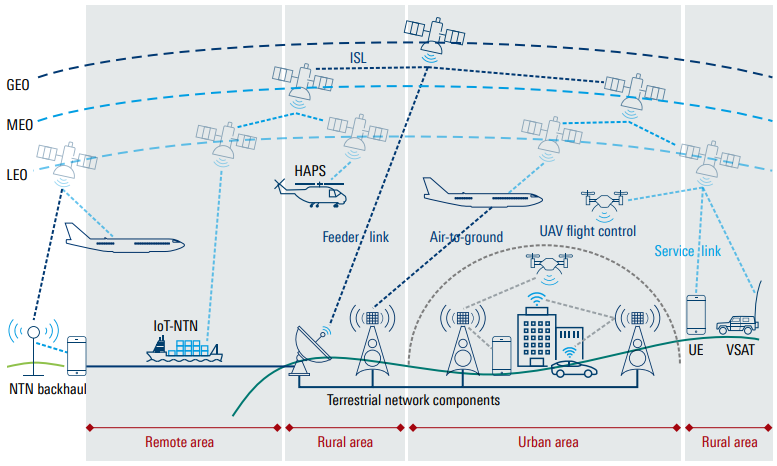
- List of Challenges
- Sorting the List : Which of These Are Permanent ?
- The Physics, in Numbers
- What 3GPP Actually Did About These
- What Has Changed Since This Page Was Written
- Challenges That Have Grown Since 2021
List of Challenges
What follows is a deliberately mixed list. It runs from things that are fixed by physics and can never be improved, through engineering problems that are hard but ultimately a matter of money and iteration, to questions that are not technical at all - what it costs to launch, whether anyone will pay for the service, and whether a regulator will allow it. They are set down here in the order they occur to an engineer thinking about the problem rather than sorted into neat categories, because that is honestly how they present themselves.
It is worth reading the list as a snapshot of the open questions rather than as a verdict. Some of these have since been answered by the specification, some have been overtaken by what operators actually built, and a few have quietly become harder than they looked. The sections after the list revisit them with that hindsight - first sorting them by whether they can improve at all, then putting numbers on the ones driven by physics, and finally comparing what was expected against what has happened since.
Sorting the List : Which of These Are Permanent ?
The list above was written as a flat set of concerns, and read that way it can feel uniformly discouraging. It is much more useful sorted, because the items do not all have the same character. Some are consequences of physics and will never improve. Some are engineering problems that money and time have already moved a long way. And some are not technical at all.
|
Family |
Items from the list above |
Can it improve ? |
|---|---|---|
|
|
Latency, Large Doppler shift, propagation delay spread across a cell |
No. These are constants. The only lever is orbit altitude, and lowering it trades delay against constellation size. Everything the specification does here is compensation, never removal. |
|
|
Antenna technology, user terminal alignment, on-board processing, power limitations, handover complexity, ground station demand, network management, scalability |
Yes, and several already have. This is the family where the most has changed since this page was first written - see What Has Changed below. |
|
|
Launch costs, user terminal cost, business case, competition with other technologies |
Partly. Launch cost per kilogram has fallen sharply with reusable boosters. Terminal cost and the business case remain genuinely open questions. |
|
|
Regulatory hurdles, orbit management and debris |
These have got harder, not easier, as constellation sizes have grown - see Challenges That Have Grown. |
The Physics, in Numbers
Three items on the list above - latency, Doppler and delay - are stated qualitatively. They are worth pinning to actual figures, because the numbers are what drove every design decision described elsewhere on this site.
|
Quantity |
LEO at 600 km |
GEO at 35,786 km |
Terrestrial macro, for scale |
|---|---|---|---|
|
Max round trip propagation delay |
12.89 ms regenerative |
270.73 ms regenerative |
Well under 1 ms |
|
Delay difference across one cell |
3.12 ms |
10.3 ms |
Fractions of a millisecond |
|
Max Doppler shift at 2 GHz |
24 ppm, i.e. approx. 48 kHz |
0.93 ppm, i.e. approx. 1.9 kHz |
approx. 0.9 kHz at 500 km/h, and only if the UE moves |
|
How fast the delay changes |
up to +/- 93 us/s |
Negligible |
Zero for a stationary UE |
|
How long a satellite stays visible |
approx. 12 minutes for a near-overhead pass |
Permanently |
The tower does not set |
Those last two rows are the ones that create work rather than merely inconvenience. A LEO satellite is visible for about twelve minutes, so a cell has to be handed over every few minutes
What 3GPP Actually Did About These
When this page was written the challenges were open questions. Most of the technical ones now have concrete answers in the specification, and it is useful to see the list mapped onto the mechanisms that resolve it.
|
Challenge |
What the specification does |
Read more |
|---|---|---|
|
Latency breaks protocol timers |
Scheduling offsets Koffset and Kmac, extended response windows and timer start offsets, and up to 32 HARQ processes with per-process feedback disabling |
|
|
Delay differs per UE in a cell |
The UE computes its own timing advance from GNSS and broadcast ephemeris before its first transmission, so the network never has to absorb the spread |
|
|
Large Doppler shift |
The UE pre-compensates the service link open loop from the same ephemeris; the network silently removes the feeder link and payload oscillator contributions |
|
|
Handover complexity |
Because satellite motion is predictable, mobility moves from measurement-triggered to time and location triggered - conditional handover with ephemeris, t-Service and neighbour assistance |
|
|
Ground station demand and reach |
Architecturally answered two ways : inter-satellite links so a satellite can reach a distant gateway, and regenerative payloads so less has to cross the feeder link at all |
|
|
On-board processing limits |
Rel-17 sidesteps it entirely - only the transparent payload is specified normatively, so the gNB stays on the ground where it can also be upgraded |
|
|
Antenna and terminal alignment |
Not solved by specification but by scope : direct-to-device operates in S band against a 0 dBi handset antenna, so no alignment is required at all. Ka band is left to directive VSAT terminals. |
|
|
Power limitations |
Addressed through coverage enhancement work and by accepting very low data rates for the IoT-NTN case rather than by finding more power |
What Has Changed Since This Page Was Written
Parts of the list above carry dates from early 2021, and several of them have simply been overtaken by events. Rather than delete the original observations - they are a useful record of what the open questions looked like at the time - here is what has happened since.
|
What the page said (2021) |
Where it stands now |
|---|---|
|
"as of Feb 2021 the communication between satellites is not supported" (inter-satellite links) |
|
|
"almost no technical details are known as of now (Mar 2021)" about AST SpaceMobile |
|
|
Handover complexity, Doppler, latency as open engineering problems |
|
|
"Larger constellations could require dozens or even tens of thousand of launches" |
|
|
"would it be lucrative enough to invest huge money to compete..." |
|
Challenges That Have Grown Since 2021
The list above is mostly a list of things that have got better. In fairness, the balance has shifted the other way in several areas, and a challenges page written today would give these more prominence than the original list did.
-
Orbital congestion and conjunction management : the original "Orbit management" bullet anticipated this, but understated the scale. With tens of thousands of active satellites either deployed or filed for, collision-avoidance manoeuvres have become routine operational overhead rather than rare events, and the long-term debris question is now a mainstream policy topic rather than a specialist one. -
Astronomy impact : large constellations affect both optical astronomy, through reflected sunlight in long exposures, and radio astronomy, through emissions near protected bands. Neither appeared on the original list and both are now a standing item in constellation licensing discussions. -
Spectrum coexistence for direct-to-device : this is the genuinely new regulatory problem. D2C transmitsterrestrial mobile spectrum from orbit , and a satellite beam does not stop at a national border the way a cell site does. Coordinating that against neighbouring countries' use of the same band is a harder regulatory question than the original "Regulatory hurdles" bullet envisaged, and it is an active topic in ITU work. -
Satellite lifetime and re-entry : short-lived LEO satellites mean a constellation is in a permanent state of replacement, so launch cadence has to be sustained indefinitely rather than being a one-off deployment cost. The atmospheric effects of large numbers of re-entering satellites are an emerging area of study. -
The link budget has not moved : this deserves emphasis because it is easy to lose in the excitement about D2C. Serving an ordinary handset with a 0 dBi antenna and 200 mW of transmit power from hundreds of kilometres away is close to the edge of what is physically possible. That is why direct-to-device started with messaging rather than broadband, and why the data rates in the specification's own requirement tables are modest. No amount of standardisation changes the link budget.
Related Pages on this Site
- NTN - What is it ? - the overview, and the collected demonstration links
- Why NTN ? - the motivation these challenges are weighed against
- NTN Architecture - payload types, ISL, and the ground station question
- NTN Timing Advance - how the latency and delay-variation challenges are actually handled
- NTN Frequency Compensation - the Doppler challenge in detail
- NTN RACH - where the differential delay challenge bites hardest
- NTN Requirement - the data rates and delays the system is actually targeted at
- NTN Spectrum - the bands, and why terminal type drives the choice
3GPP Reference
- Non-Terrestrial Networks (NTN) - 3GPP Technology Article (2024)
- 3GPP TR 38.811 : Study on New Radio (NR) to support non-terrestrial networks - where the physics of the challenge list is characterised
- 3GPP TR 38.821 : Solutions for NR to support non-terrestrial networks (NTN) - the solution study behind most of the answers above
- 3GPP TS 38.300 : NR and NG-RAN Overall Description - clause 16.14, the normative NTN behaviour
- 3GPP TS 38.101-5 : NR; UE radio transmission and reception; Part 5: Satellite access - the RF reality behind the link budget point
- 3GPP TR 36.763 : Study on NB-IoT / eMTC support for Non-Terrestrial Networks - the IoT-NTN counterpart
Other References
- Non-terrestrial networks (NTN) - R&S
- Non-Terrestrial Network Advantages, Challenges, and Applications - Keysight
- 5G & Non-Terrestrial Networks - 5G Americas White Paper (2022)
- LEO Small-Satellite Constellations for 5G and Beyond-5G Communications
- Satellite Communications in the New Space Era: A Survey and Future Challenges
- 5G from Space: An Overview of 3GPP Non-Terrestrial Networks
- AST SpaceMobile