Hill Function
It is very usefull function to approximate various degree of Hard Limitor (Similar to Step function) just by changing Ka, A, n in the following equation. This is very widely used in BioChemistry.
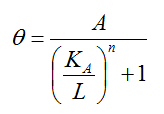
Example 1 > When n > = 0
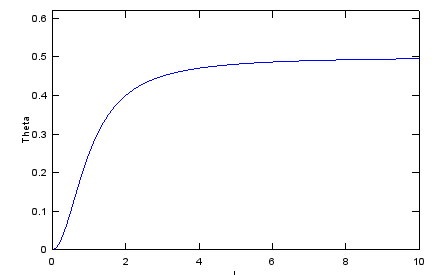
n = 2;
A = 0.5;
Ka = 1.0;
L = 0:0.1:10;
Theta = A ./((Ka ./ L).^n .+ 1);
plot(L,Theta); xlim([L(1),L(length(L))]); ylim([0,1.25 .* max(Theta)]);xlabel('L');ylabel('Theta');
Example 2 > When n > = 0
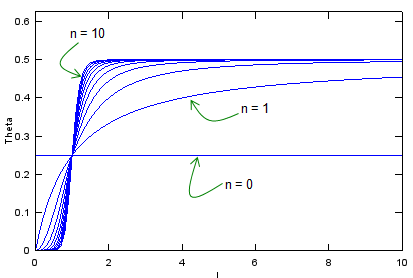
A = 0.5;
Ka = 1.0;
L = 0:0.1:10;
for n=0:1.0:10
Theta = A ./((Ka ./ L).^n .+ 1);
plot(L,Theta); xlim([L(1),L(length(L))]); ylim([0,1.25 .* max(Theta)]);xlabel('L');ylabel('Theta');
hold on;
end;
Example 3 > When n < = 0
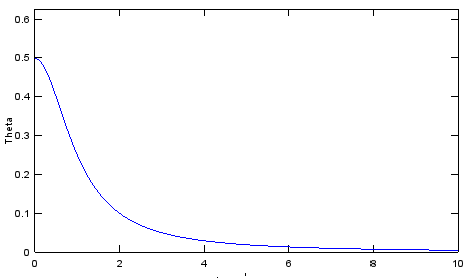
n = -2;
A = 0.5;
Ka = 1.0;
L = 0:0.1:10;
Theta = A ./((Ka ./ L).^n .+ 1);
plot(L,Theta); xlim([L(1),L(length(L))]); ylim([0,1.25 .* max(Theta)]);xlabel('L');ylabel('Theta');
Example 4 > When n < = 0
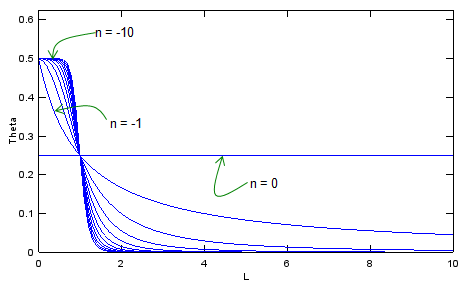
A = 0.5;
Ka = 1.0;
L = 0:0.1:10;
for n=0:-1.0:-10
Theta = A ./((Ka ./ L).^n .+ 1);
plot(L,Theta); xlim([L(1),L(length(L))]); ylim([0,1.25 .* max(Theta)]);xlabel('L');ylabel('Theta');
hold on;
end;