Data science is a term that almost everyone uses and almost nobody defines the same way. This page does not try to settle the definition. I'll first go through a few ways of defining it, and then show a search trend for data science and two related terms. After that we'll place data science next to statistics, machine learning and big data. The page ends with a collection of videos by working data scientists and analysts.
- What is Data Science ?
- Big Trends
- How does data science relate to statistics, machine learning and big data ?
- Video Digest
What is Data Science ?
Data science has no single agreed definition, so let's approach it from three directions. The first is a short formal definition. The second borrows the definition of science itself, and the third is a practical view of how data science differs from ordinary data analysis.
Data Science is a branch of science that takes 'Data' as subject of the science.
I know you don't like this definition :) and this definition would not give you any clear understanding of Data Science.
Before we try to understand 'Data Science', let's think of 'What is Science ?'.
Following is the first line of definition of Science from Wikipedia.
Science (from Latin scientia, meaning "knowledge") is a systematic enterprise that builds and organizes knowledge in the form of testable explanations and predictions about the universe.
If you replace the term 'universe' with the term 'Data', I think it can be a pretty accurate formal definition of the data science.
Science (from Latin scientia, meaning "knowledge") is a systematic enterprise that builds and organizes knowledge in the form of testable explanations and predictions about the Data.
It may sound pretty accurate, but I know you don't like this definition either. It is too dry.. and it doesn't sound practical to me.
However, if you want to define any terminology in practical sense, usually we may end up with the description that 'sound easy' but 'can be interpreted in too many different ways'. If you ask ten people to define 'Data Science' in practical sense, you might have ten different definition. But if you just put the ten different definition into your brain and keep it for some time, your brain would come up with 'some kind of understanding' on its own even though you may not be able to express it in your own words. Or just watch all the video listed below and if possible search a couple of more videos you can search from YouTube, you will have some form of understanding and I think your understanding will be correct whatever it is.
Following is my personal understanding of 'Data Science' after watching all the videos linked below.
In usual data analysis that we have done, we are give a certain set of data (usually structured data that is stored in a well defined format, like data base table). and we are also given a predefined 'question' (analysis target) we need to find the answer from the data. and in most case the methods/techniques for the analysis is known in advance.
On the contrary, in Data Science we are given a set of data (usually Big Data) and we don't even know what kind of questions we need to ask about the data.. and in many case we don't know what kind of methodology we have to use. So in many case of Data Science, 'making a question (finding 'what to ask') is the first thing we have to do' and then we have to figure out 'what kind of methodology we need to find the answers to the question'. It is like Scientist do in other scientific area.
This is a little bit of risky definition (you may not agree with this definition), but if you push me to find more practical definition... I would say 'Data Science' is just a marketting term that become popular as another marketting term 'Big Data' gets attention from many people. As you may see in Big Data page, the conventional technology would not work very well with Big Data and we need to find new knowledge and methodology to analyze those Big Data and those new knowledge/technology tend to be called as 'Data Science'.
Most working definitions share a common core. They describe data science as the overlap of three skills: statistics and mathematics, programming and data handling, and knowledge of the field that the data comes from. A typical project also follows a similar sequence of steps. It starts with a question, then collects and cleans the data, explores it, builds a model and finally communicates the result.
Data science starts from the question : in ordinary analysis the question is given, while in data science finding the right question is part of the work.It needs three kinds of skill : statistics, programming and domain knowledge. Missing any one of them limits the result.The term grew with big data : the new methods for data that conventional databases cannot handle are what people now call data science.
Big Trends
Just for your reference, I checked Google Trend with a few key words related to Data Science. I would not try to interpret this trend myself which may mislead the readers. I will leave it up to each of the readers regarding the interpretation of this result. It would be a good practice to search through some additional data and try to interpret the trend plot show here if you are realy interested in this area -:)
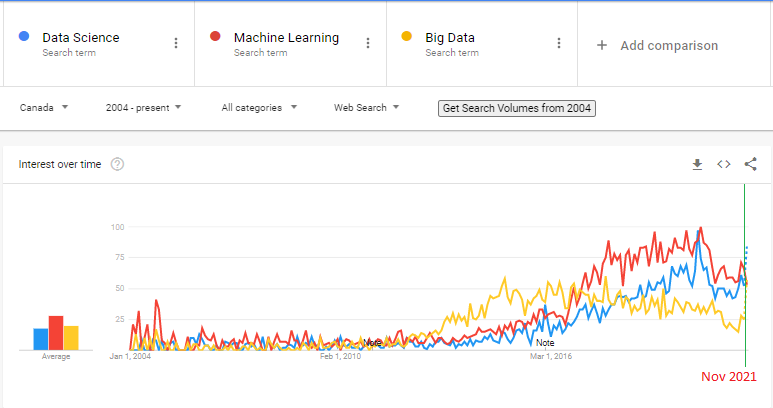
Before you interpret the chart, check how it is scaled. The chart compares Data Science in blue, Machine Learning in red and Big Data in yellow. It covers web searches in Canada from 2004 to November 2021, and the green line at the right edge marks the capture date. The vertical axis does not count searches. Google Trends scales every curve so that the highest point in the whole chart is 100, and every other point is a percentage of that peak. So the chart shows how the interest in each term changed over time, relative to the other two terms. The bar chart at the left gives the average of each curve over the whole period. The markers labeled Note are points where Google changed its data collection, so a step at one of those points may not be a real change in interest.
The values are relative : 100 is the peak of the busiest term in this chart, not a number of searches.The region and period are fixed : a different country or a later capture date gives different curves.You can repeat the search : Google Trends lets you add terms, change the region and extend the period past November 2021.
How does data science relate to statistics, machine learning and big data ?
The three terms in the chart overlap, and job titles overlap even more. So it helps to separate what each field is about. The boundaries are not sharp, but the core of each one is clear.
Statistics is the oldest of the fields. It provides the tools for estimating quantities from samples and for testing whether a pattern is real or only noise. The covariance matrix and PCA are examples of such tools. Machine learning builds models that learn a mapping from data, for example from an image to a label, and it measures success by prediction accuracy on new data. Big Data describes the data itself and the systems that store and process it. Data science uses all three. It takes the questions and the checks from statistics, the models from machine learning, and the data and infrastructure from big data.
The job titles follow the same split, and several videos below compare them. A data analyst usually answers given questions with existing data and reports the results. A data scientist also forms new questions and builds models. A data engineer builds the pipelines and storage that deliver the data, and an ML engineer turns a model into a product that runs reliably.
Statistics decides whether a pattern is real : without it, a model can learn noise.Machine learning provides the models : see the Machine Learning pages for details.Big data provides the raw material : the data and the systems to handle it come first.
Video Digest
The videos below are grouped by type, from short introductions and career talks to full online courses and documentaries. Several of them compare the roles of data analyst, data scientist and data engineer. They were collected when this page was written, so some links may no longer work.