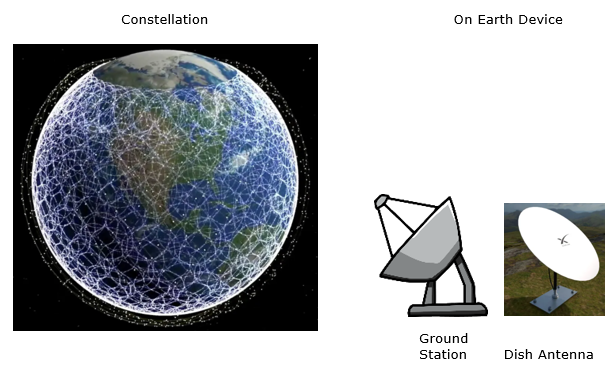
Starlink is a satellite internet constellation operated by SpaceX, providing high-speed, low-latency broadband internet globally. It uses a constellation of low Earth orbit (LEO) satellites to deliver internet service, particularly to remote and rural areas where traditional internet access has been unreliable or unavailable. Users can connect to the Starlink network by setting up a small satellite dish at their location and recently (early 2024) connect to the satellite directly with regular mobile phone, which receives the signal from the satellites. The goal of Starlink is to create a low latency network in space that facilitates edge computing on a global scale
Orbits and Constellation
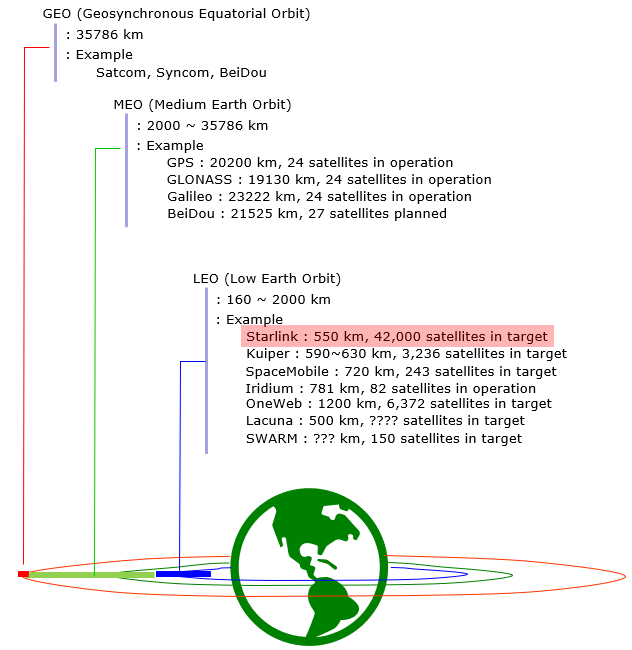
Starlink is a satellite internet constellation operated by SpaceX, providing global coverage. The Starlink satellites orbit at an altitude of approximately 550 kilometers (342 miles) above the Earth. As of July 2023, there are 4,519 Starlink satellites in orbit, with 4,487 of them operational. The constellation is designed to deliver broadband internet from low Earth orbit, and it is the world's first and largest satellite constellation of its kind
Spectrum (Frequency and Bandwidth)
Starlink supports various frequency bands for its satellite internet services. The Ka band, which ranges from 27-40GHz, and the Ku band, which ranges from 12-18GHz, are used for broadband satellite internet services. Additionally, Starlink also utilizes the V band (40-75GHz), X band (8-12GHz), and K band (18-27GHz) for its operations. The available bandwidth of Starlink satellites to user terminals is 2000 MHz in the Ku-band, and 500 MHz from the terminal to the satellite.
In terms of data transmission, the ranges from 10.7-12.7GHz and 37.5-42.5GHz are used for the transmission of data from Starlink, while the ranges from 17.8-18.6GHz, 18.8-19.3GHz, and 37.5-42.5GHz are used for satellite to gateway transmissions.
For uplink communications, the ranges used for sending information from the gateways back up to the satellites are 47.2-50.2GHz and 50.4-51.4GHz. The downlink communications for tracking, telemetry, and control are in the ranges of 12.15-12.25GHz, 18.55-18.6GHz, and 37.5-37.75GHz, while the uplink communications for the same purpose are in the ranges of 13.85-14GHz and 47.2-47.45GHz
The maximum data rate provided by Starlink is up to 220 Mbps for download speeds. The upload speeds are typically between 5 and 20 Mbps. These speeds make Starlink a competitive option for high-speed internet, especially in rural areas or for users seeking a mobile internet option
FCC
[1] FCC Authorizes SpaceX to Provide Broadband Satellite Services (Mar 2018)
[2] Application for Fixed Satellite Service by Space Exploration Holdings, LLC (Nov 2018)
[3] APPLICATION FOR BLANKET LICENSED EARTH STATIONS
[4] 2AWHPR201 (Starlink Router)
[5] QUESTION 7: PURPOSE OF EXPERIMENT
[6] QUESTION 7: PURPOSE OF EXPERIMENT
YouTube - Technical
- Using ground relays with Starlink (Dec 2019)
- SpaceX & Starlink: Is Satellite Internet a Good Idea? (Aug 2020)
- Starlink Teardown: DISHY DESTROYED! (Nov 2020)
- Starlink - Deep Dive and How It Works (Dec 2020)
- TSP #181 - Starlink Dish Phased Array Design, Architecture & RF In-depth Analysis (Jan 2021)
- STARLINK Ground Station UPDATE *Interactive Map* (Mar 2021)
- Why Starlink Is Crucial To SpaceXs Success (Apr 2021)
YouTube - General Info
- Making Humans a Multiplanetary Species (Sep 2016)
- How SpaceX Is Changing the Space Industry (Mar 2018)
- How does SpaceX transport the Falcon 9? (Apr 2018)
- The Rise of SpaceX Elon Musk's Engineering Masterpiece (Oct 2020)
- Starlink Beta Answers: Mobility for RVs & Boats? Geo Lock? Data Caps? Lasers? Power Consumption (Nov 2020)
- Starlink Beta Expands to RVer Domicile Addresses in South Dakota - But It's NOT Mobile Yet (Jan 2021)
- The Major Issues With SpaceX's Starlink (Dec 2020)
- SpaceX Starship SN10 soars, lands for first time! (Mar 2021)
- Starlink High-Speed Internet For Everyone | w/ Warren Redlich (Mar 2021)
- Starship SN11 Flight Test (Mar 2021)
- Starlink Internet One Month Update + Distance From Service Address Test (Mar 2021)
- Starlink for RVers and Boaters? Reality Check on FCC Filing for Mobility (Mar 2021)
Reference :
- Starlink (Wikipedia)
- STARLINK SPECIFICATIONS
- SpaceX Starlink Satellite Internet Service (Mar 2021)
- What Is Starlink? SpaceX's Much-Hyped Satellite Internet Service Explained (Mar 2021)
- Starlink launches 60 more satellites but commercial service faces delays (Nov 2020)
- Starlink Explained: What You Need to Know About Elon Musk's Satellite Internet Service - CNET(Jun 2023)
- Starlink satellites: Everything you need to know about the controversial internet megaconstellation - SPACE (Aug 2023)
- What Frequency Does Starlink Use? - American TV
- Unintended electromagnetic radiation from Starlink satellites detected with LOFAR between 110 and 188 MHz - Astronomy & Astrophysics (Aug 2023)
- Signal Structure of the Starlink Ku-Band Downlink - (2023)
- A Multifaceted Look at Starlink Performance - (2024)
- Direct-to-Cell: A First Look into Starlink’s Direct Satellite-to-Device Radio Access Network through Crowdsourced Measurements - arXiv (2025)
- Throughput Analysis of Starlink Satellite Internet: Study on the Effects of Precipitation and Hourly Variability with TCP and UDP - SPACOMM (2025)
- The Starlink Robot: A Platform and Dataset for Mobile Satellite Communication - arXiv (2025)
- Performance Evaluation of Satellite-Based Data Offloading on Starlink Constellations - arXiv (2025)
- Starlink and Satellite Broadband Coverage Mapping - ResearchGate (2025)