Power on a receiver and it knows almost nothing. It does not know the exact frequency it is listening on. It does not know where one symbol ends and the next begins. It does not even know whether anything is transmitting. Initial synchronization is the process that turns that state into a working link, and every radio technology has to solve it somehow.
- What does a receiver know when it powers on ?
- How do different technologies do it ?
- What is common to all four ?
What does a receiver know when it powers on ?
Start with the honest answer, which is close to nothing. The receiver has a rough idea of which band to look in, because that is built into it, and everything else has to be discovered. Four things are missing, and the order in which they are recovered is forced rather than chosen.
The first is frequency. A receiver's crystal oscillator is not exact, and an uncalibrated part is specified in tens of parts per million. Ten parts per million sounds negligible until you apply it to a 2 GHz carrier, where it becomes a 20 kHz error. LTE spaces its subcarriers 15 kHz apart, so an error that size carries the signal past its own subcarrier and into the neighbour. Demodulation cannot even begin until that is corrected.
The second is time, and it arrives in layers. The receiver has to find the sample timing first, then the symbol boundary, then the frame or slot boundary. An error of a fraction of a symbol smears energy from one symbol into the next. An error of a whole frame is harder to spot. Every sample decodes correctly, and every field still lands in the wrong place.
The third is identity. Several transmitters usually share a band, so finding a signal is not the same as finding the right one. The receiver has to work out which cell, access point or device it has found before it can decide whether to stay with it.
The fourth is everything the transmitter has to tell it: the bandwidth in use, the configuration, and the procedure for asking to join. That information travels in a broadcast the receiver can only read once the first three are solved, which is why the order is forced. You cannot be told the parameters until you can already receive.
Frequency comes first because nothing else works without it : a crystal error of tens of parts per million exceeds one subcarrier spacing at cellular frequencies. The subcarriers are simply not where the receiver expects them.Timing has to be solved twice : once at symbol level to stop energy leaking between symbols, and again at frame level so that fields land where the receiver looks for them.Finding a signal is not finding the right signal : identity is a separate problem, and a receiver that skips it will happily synchronize to a neighbouring cell.The order is forced, not chosen : the parameters a receiver needs are broadcast, and reading a broadcast needs frequency, timing and identity already in hand.
How do different technologies do it ?
The same problem appears in every radio system, and the solutions resemble each other without being identical. The drawing below sets four of them side by side as message exchanges. Each panel names its two participants at the top of their own vertical line. Read each panel from top to bottom.
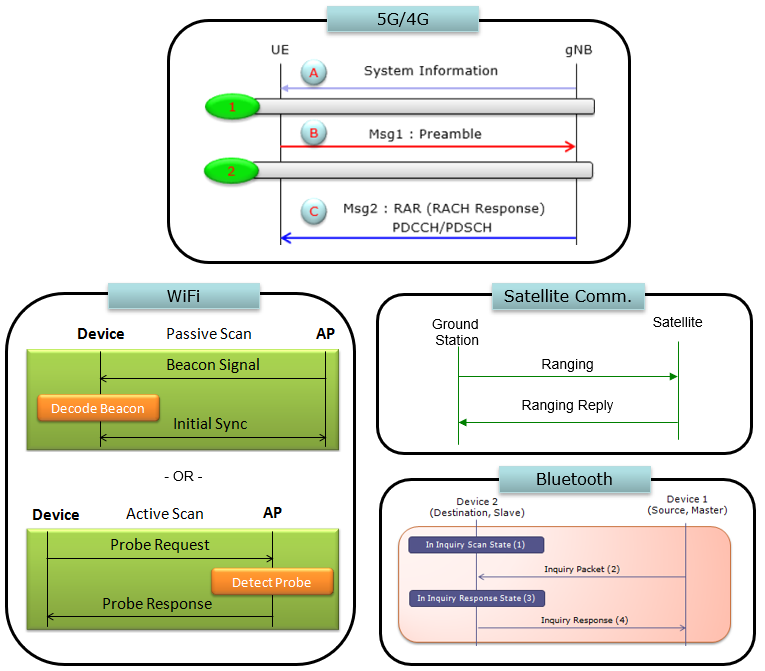
Figure 1. Initial synchronization in four technologies, one panel each. The exchanges differ in who moves first and in what the first signal is called, and every one of them ends with both ends having heard from the other.
The 5G and 4G panel labels three steps. At A the gNB broadcasts System Information and the UE receives it, so the network moves first. At B the UE sends Msg1, a preamble, which is the first thing the UE ever transmits. At C the gNB answers with Msg2, the RAR, carried on PDCCH and PDSCH. The two grey bars marked 1 and 2 group the exchange into a listening stage and a transmitting stage.
That panel compresses one step, and it is worth knowing which. Before a UE can read System Information it has to find the synchronization signals that carry the frame timing and the cell identity. Those come first in the real procedure, and the drawing starts after them.
WiFi is the only panel that draws two alternatives, separated by the words - OR -. In the passive scan the AP transmits a Beacon Signal, the device decodes it, and the arrow marked Initial Sync spans that whole operation. In the active scan the device moves first with a Probe Request, the AP detects it, and answers with a Probe Response. Either route ends with the same working link.
The satellite panel is the shortest and it is a plain two-way exchange. The ground station sends Ranging and the satellite sends Ranging Reply. The name says what the exchange is for. It measures the round trip time, because the propagation delay on a satellite link is far too large to assume.
Bluetooth numbers its four steps. Device 2 sits in the Inquiry Scan State at step 1, so it is listening. Device 1, labelled Source and Master, sends an Inquiry Packet at step 2. Device 2 moves to the Inquiry Response State at step 3 and sends an Inquiry Response at step 4. The master is the device that starts the exchange, and the slave is the one that answers.
The table below reduces the four panels to the two questions that actually separate them.
5G / 4G |
Network |
System Information |
Yes |
Msg1 preamble, then Msg2 RAR |
WiFi, passive scan |
AP |
Beacon Signal |
Yes |
Nothing, for sync itself |
WiFi, active scan |
Device |
Probe Request |
No |
Probe Response |
Satellite |
Ground station |
Ranging |
No |
Ranging Reply |
Bluetooth |
Master |
Inquiry Packet |
No |
Inquiry Response |
Only the names are really different : beacon, System Information, ranging burst and inquiry packet are four words for a signal the other end already knows how to look for.Who moves first is a design choice, not a law : WiFi draws both answers for the same technology, which is the clearest evidence that neither is forced.Every panel ends with a two-way exchange : even the satellite panel, which has no broadcast at all, still needs the reply before the link counts as established.
What is common to all four ?
Strip the vocabulary away and the four panels run the same three phases in the same order. Seeing that shape once makes an unfamiliar technology much easier to read, because the panel for it will have the same three parts under different names.
The first phase is a transmission that the other end already knows. The content of a beacon, a preamble, a ranging burst or an inquiry packet barely matters. What matters is that both ends agreed on it in advance, because the receiver is about to search for it rather than decode it.
The second phase is that search, and it is where the unknowns from the first section are actually solved. The receiver correlates the incoming samples against the pattern it expects. A correlation peak appears where the two line up, and the position of that peak is the timing. The phase rotation across the peak is the frequency error. One operation recovers both.
The third phase makes the link mutual. Until the other end has answered, the receiver is synchronized to a transmitter that does not know it exists. That is useful for listening and useless for anything else. That is why even the satellite panel, with no broadcast and no cell to select, still shows a reply.
Figure 2. The same three phases sit under every panel in Figure 1. The names change between technologies and the order does not, because each phase depends on the one before it.
One difference between the panels is worth a paragraph of its own, and the WiFi panel is the reason. Passive and active discovery are two answers to the same question, and WiFi draws both.
In passive discovery the network transmits periodically and the device waits. The cost falls on the network, which spends airtime on a beacon whether anybody is listening or not, and the device pays only in patience. In active discovery the device transmits and the network answers. Now the cost falls on the device, which spends power at the moment it asks, and the network spends nothing while nobody is asking.
The choice follows from how many devices there are and how often they arrive. A cell serves many devices at once, so one periodic broadcast serves all of them and passive discovery is the clear choice. Two Bluetooth devices meet occasionally and spend most of their lives apart. A permanent beacon would waste power on both sides, so the inquiry procedure in the drawing asks only when somebody wants to connect.
Known signal, correlate, reply : three phases in that order, and no technology in the drawing skips one of them.One correlation recovers both timing and frequency : the peak position gives the timing, and the phase rotation across the peak gives the frequency error. The known signal therefore has to be long enough to measure a rotation across.Passive costs the network, active costs the device : a periodic broadcast spends airtime whether or not anyone is listening, and an on-demand probe spends battery only when it is used.Many devices favour passive, occasional meetings favour active : that single trade explains why a cell broadcasts and why two Bluetooth devices do not.