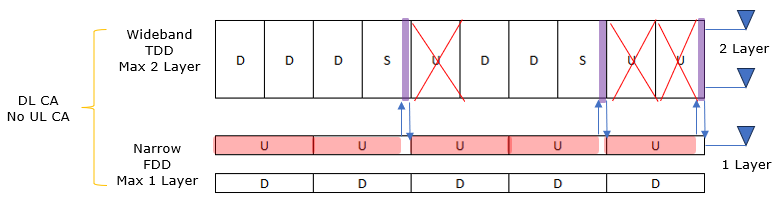
In many 5G NR deployments, a UE is anchored on a low-band FDD carrier for reliable uplink coverage, while a mid/high-band TDD carrier is added for huge downlink capacity with massive MIMO. The problem is that the gNB cannot fully exploit DL beamforming on the high band unless it can learn the uplink channel there, because TDD beamforming typically depends on reciprocity and an uplink reference such as SRS. However, the UE may not have enough simultaneous Tx RF chains to keep transmitting on the high band, and the uplink coverage on that band may be too weak for sustained PUSCH. SRS Carrier Switching solves this by letting the UE time-share the same transmitter: it pauses uplink on the source carrier, retunes the RF to the target carrier, transmits an SRS burst only to “sound” the channel, and then retunes back to resume normal operation. This switching creates an unavoidable interruption gap, so the scheduler must avoid UL/DL timing conflicts during the retune window, and it must also apply collision rules where high-priority signals like SR or ACK/NACK can override the planned SRS. This is different from SRS antenna switching, which rotates the Tx chain across antenna ports on the same carrier, while carrier switching moves the same chain across different frequencies, and it also explains why UL CA is not required, because the transmission is sequential rather than simultaneous.
Clearing Up Confusion with other UL switching features
In NR uplink discussions, terms like UL Tx switching, SUL, SRS antenna switching, and SRS carrier switching often sound like the same idea because they all involve “moving something” in the uplink side, either across frequency or across antenna resources. But the key is to separate the object being switched and the purpose of the transmission. SUL and UL Tx switching are uplink capacity/coverage features, so they exist to carry real uplink traffic, meaning PUSCH and sometimes PUCCH are part of the intention. SRS antenna switching is also a reference-signal driven mechanism, but it stays on the same carrier and mainly rotates limited Tx resources across antenna ports so the gNB can build a better MIMO picture on that band. SRS carrier switching is the special case that looks like inter-carrier uplink activity but is not trying to move any user or control data to the target carrier at all. The UE temporarily retunes only to “probe” the target band by sending SRS, so the gNB can estimate that band’s channel for downlink beamforming, and then the UE immediately returns to its normal uplink carrier. The defining point is that SRS carrier switching is an SRS-only operation on the target carrier, while the other uplink switching features are designed to deliver uplink data or uplink coverage improvement
Why the terms feel similar - All of them involve “switching” behavior on the uplink side.
- The switch can be frequency-related (move Tx to another carrier) or resource-related (reuse limited Tx chains/antennas).
The clean way to de-confuse - Step 1: Check what is being switched: carrier frequency vs antenna port vs uplink path.
- Step 2: Check what is being transmitted: SRS only vs real UL traffic (PUSCH/PUCCH).
- Step 3: Check the goal: downlink MIMO optimization vs uplink coverage/speed.
SRS Carrier Switching - Switching what? Tx chain retunes across different carriers (different frequency CCs).
- What is transmitted on target carrier? SRS only.
- PUSCH/PUCCH on target carrier? No. This is the defining point.
- Main goal: gNB measures the uplink channel on the target band to improve DL beamforming / DL MIMO (typically TDD high band).
- Typical scenario: UE stays UL-reliable on low-band FDD, but gNB wants DL gains on mid/high-band TDD.
SRS Antenna Switching - Switching what? Tx chain cycles across antenna ports on the same carrier.
- What is transmitted? SRS across different ports.
- Main goal: Improve spatial channel knowledge to enable higher-rank DL MIMO on the same band.
- Why it matters: UE may have limited Tx chains but multiple Rx antennas, so it needs to sound multiple spatial paths efficiently.
UL Tx Switching - Switching what? Tx chain retunes across carriers (often FDD ↔ TDD sharing).
- What is transmitted on target carrier? Actual uplink traffic.
- PUSCH on target carrier? Yes. This is the key difference vs SRS carrier switching.
- Main goal: Improve uplink performance (coverage / throughput), often to support more UL layers or better UL utilization on a band.
SUL (Supplementary Uplink) - Switching what? UE uses a different uplink carrier than the downlink carrier (DL on higher band, UL on lower band).
- What is transmitted? Real UL traffic on the SUL carrier (PUSCH/PUCCH as configured).
- Main goal: Improve uplink coverage, especially at cell edge.
The one-sentence differentiator - SRS Carrier Switching: Inter-carrier switch for measurement only (SRS), not for uplink data.
- UL Tx Switching / SUL: Inter-carrier uplink solutions that carry uplink data/control.
- SRS Antenna Switching: Intra-carrier SRS across antennas to improve spatial channel knowledge.
Practical implications - Scheduler view (SRS CS): Target carrier UL is a sounding opportunity, not a traffic pipe.
- Scheduler view (UL Tx Switching / SUL): Must plan for real UL grants, power, HARQ timing, and control conflicts.
Common pitfall - Mistake: Seeing a UE hop to a different carrier and assuming UL CA or UL data on that carrier.
- Reality: For SRS carrier switching, it is TDM probing, not simultaneous UL data.
SRS Carrier Switching vs UL CA
SRS Carrier Switching is used mainly for DL only CA setup only. If it is in DL/UL CA, this switching would not be needed because in UL CA SRS for both carrier is being transmitted without switching.
SRS Carrier Switching is mainly used in a DL-only CA setup. In this case, the UE is configured with multiple CCs for downlink reception, but it still uses only one main uplink carrier for real UL transmission. The gNB still wants to run strong DL MIMO and beamforming on the secondary high-band carrier, so it needs uplink sounding on that carrier to estimate the channel. However, since the UE is not transmitting UL on that secondary carrier, there is no “natural” uplink signal there, and the UE may not have enough simultaneous Tx RF chains to transmit uplink on both carriers at the same time. This is why the UE temporarily retunes to the target carrier and transmits SRS only, and then it returns back to the source uplink carrier.
If the deployment is DL/UL CA, the situation changes. In UL CA, the UE can transmit uplink on multiple carriers simultaneously, which implies that the uplink RF chain resources are available to support those carriers at the same time. In that condition, the UE can transmit SRS on each uplink carrier directly as part of the normal UL operation, so the gNB can obtain channel measurements for each carrier without any special retuning procedure. As a result, the “borrow-and-return” mechanism of SRS Carrier Switching is typically not needed, because the UE does not need to time-share a single transmitter to create uplink sounding on the other carrier.
The fundamental logic behind this feature is.
- If you have Uplink CA (DL/UL CA): You have two active transmitters (RF Chains) running simultaneously. You don't need to "switch" or "steal" the transmitter from the FDD band to sound the TDD band—you just use the TDD transmitter that is already active.
- If you have DL-only CA (SRS Switching): You have Downlink on the TDD band, but no Uplink data path. You likely only have one active transmitter (on FDD). To measure the TDD channel, you must briefly "switch" that single transmitter over to TDD.
Here is the comparison to make it concrete.
Scenario 1: Full Uplink CA (No Switching Needed)
- Setup: UE connects to Low Band (FDD) + High Band (TDD).
- Hardware: The UE has 2 separate Power Amplifiers (PAs) active at the same time.
- Behavior:
- FDD Band: Sends Data + SRS.
- TDD Band: Sends Data + SRS.
- Result: The UE sends SRS on the TDD band naturally using its dedicated TDD hardware. No interruption on the FDD band occurs.
Scenario 2: SRS Carrier Switching
- Setup: UE connects to Low Band (FDD) + High Band (TDD).
- Hardware: The UE has only 1 Power Amplifier (PA) (or wants to save battery by only using one).
- Problem: The network wants to send DL data on TDD (Massive MIMO), but the UE has no transmitter turned on there to send the pilot signal (SRS).
- Solution: The UE stops the FDD transmission, retunes that single PA to the TDD frequency, sends the SRS, and retunes back.
Why not just always use UL CA?
If UL CA avoids the "switching gap" and the complexity, why don't we use it everywhere?
- Cost: A UE with 2 simultaneous transmitters (2Tx) is more expensive than a UE with 1 transmitter (1Tx). SRS Carrier Switching allows cheaper phones to still get gigabit speeds on the Downlink.
- Battery: Running 2 Power Amplifiers drains the battery twice as fast. If the TDD Uplink is weak (bad coverage), it's a waste of energy to keep that PA on for data. It's better to keep it off and only pulse it for SRS.
- Coverage: High-band TDD (e.g., 3.5 GHz) often has terrible uplink range. The UE might be able to hear the TDD tower (Downlink), but it can't shout back loud enough for Data (Uplink). However, it can shout back just loud enough for a short SRS burst.
Summary Visual
|
Feature |
Uplink Config |
Hardware Status |
SRS Method |
|---|---|---|---|
|
UL CA |
Uplink on Both Bands |
2 active PAs (Simultaneous) |
Direct transmission (No interruption) |
|
SRS Carrier Switching |
Uplink on Primary Only |
1 active PA (Shared/TDM) |
Tune-away & Return (Interruption on Primary) |
UE Capability Information
In the UE capability report, the UE provides the network with the required switching interruption times and, in newer releases, which other bands in the same band combination are affected during the switch. The network uses this information to schedule appropriate gaps, avoid collisions with uplink data, and apply the correct drop/overlap rules when SRS switching coincides with other transmissions.
BandParameters-v1540 ::= SEQUENCE {
srs-CarrierSwitch CHOICE {
nr SEQUENCE {
srs-SwitchingTimesListNR SEQUENCE (SIZE (1..maxSimultaneousBands))
OF SRS-SwitchingTimeNR
},
eutra SEQUENCE {
srs-SwitchingTimesListEUTRA SEQUENCE (SIZE (1..maxSimultaneousBands))
OF SRS-SwitchingTimeEUTRA
}
} OPTIONAL,
srs-TxSwitch SEQUENCE {
supportedSRS-TxPortSwitch ENUMERATED {
t1r2,
t1r4,
t2r4,
t1r4-t2r4,
t1r1,
t2r2,
t4r4,
notSupported
},
txSwitchImpactToRx INTEGER (1..32) OPTIONAL,
txSwitchWithAnotherBand INTEGER (1..32) OPTIONAL
} OPTIONAL
}
SRS-SwitchingTimeNR ::= SEQUENCE {
switchingTimeDL ENUMERATED {n0us, n30us, n100us, n140us, n200us, n300us,
n500us, n900us} OPTIONAL,
switchingTimeUL ENUMERATED {n0us, n30us, n100us, n140us, n200us, n300us, n500us,
n900us} OPTIONAL
}
BandParameters-v1730 ::= SEQUENCE {
-- R1 39-3-2 Affected bands for inter-band CA during SRS carrier switching
srs-SwitchingAffectedBandsListNR-r17 SEQUENCE (SIZE (1..maxSimultaneousBands))
OF SRS-SwitchingAffectedBandsNR-r17
}
BandCombination-UplinkTxSwitch-v1900 ::= SEQUENCE {
bandCombination-v1900 BandCombination-v1900 OPTIONAL,
-- R1 67-5: Enhanced handling of simultaneous SRS carrier switching and uplink Tx switching
simultaneousSRS-UplinkTxSwitch-r19 ENUMERATED {max, sum} OPTIONAL,
supportedBandPairListNR-v1900 SEQUENCE (SIZE (1..maxULTxSwitchingBandPairs))
OF ULTxSwitchingBandPair-v1900 OPTIONAL,
uplinkTxSwitchingBandParametersList-v1900 SEQUENCE (SIZE (1..maxSimultaneousBands))
OF UplinkTxSwitchingBandParameters-v1900 OPTIONAL
}
It is designed to work together with the switching-time reporting, so the UE includes the same number of entries and in the same order as the corresponding srs-SwitchingTimesListNR. For each inter-band “source–target” switching case represented in the switching-times list, the UE provides a bit string that marks which other bands in the combination are affected by that SRS switch.
The network uses this information to apply the correct dropping rules / timelines when SRS switching overlaps with other uplink activity in the same symbol. For intra-band cases (no true inter-band retune), the UE sets the bit string to all zeros, meaning there are no “other-band” impacts to account for beyond the band itself.
The content is typically split into switchingTimeDL and switchingTimeUL, describing the blocking time seen on downlink reception and uplink transmission respectively. The values are represented in discrete steps such as n0us for 0 µs, n30us for 30 µs, and so on, so the scheduler can treat them as well-defined timing penalties rather than free-form delays.
This IE is signaled per pair of bands per band combination, and the switching-time fields are mandatory when that NR band-pair switching capability is supported; otherwise the fields are absent. The network uses these values to avoid scheduling DL/UL activity during the retune window and to prevent collisions when SRS switching would otherwise overlap with data transmissions.