Since many physical layer things (e.g, sub carrier spacing, OFDM symbol length) varies in 5G/NR, you would see many physical layer parameters are specified by equations and variables instead of specific constants values. It would be good to have a few fundamental timing units that are frequently used in various part of physical layer specification. In this note, I am trying to collect a list of basic timing units being used in NR specification.
Basic Time Units
Two sampling times appear throughout the physical layer specification. Most durations in NR are written as a multiple of one of them. The first is tied to the widest subcarrier spacing the definition allows. The second is tied to 15 kHz, and the ratio between the two is a constant with a symbol of its own.
38.211 - 4.1 General defines following Time Units.
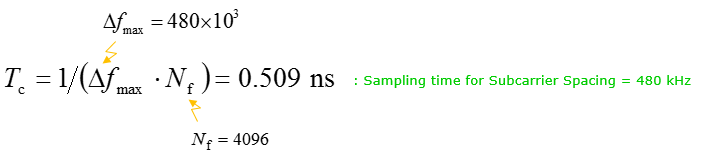
This (Tc) is basic timing unit in NR. The NR basic timing unit is defined to be the shortest/smallest sampling time possible which is the case of widest subcarrier spacing in NR as of release 15 specification (
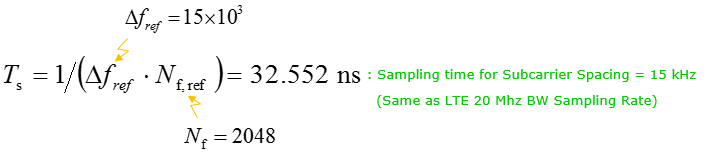
This (Ts) is another type of timing unit specifically for the case where the subcarrier spacing is 15Khz. This corresponds to the sampling rate for LTE 20Mhz BW
This (Κ, Kappa) is the ratio between Ts and Tc. This is mostly used in the specification of NR PRACH format as shown here.

Tc is the reference for everything else : 1 divided by the product of 480 kHz and 4096, which gives 0.509 ns.Ts is the 15 kHz sampling time : 1 divided by the product of 15 kHz and 2048, which gives 32.552 ns.The two differ by exactly 64 : that ratio is Κ, and PRACH formats are written in terms of it rather than in seconds.Ts is the LTE 20 MHz sampling rate : durations carried over from LTE therefore keep the values they had there.
Frame and Subframe Duration
The frame and the subframe are the two durations NR did not change. Both are defined in the same style as the sampling times, as a whole number of Tc rather than directly in seconds. Both also match the value LTE already used.
38.211 - 4.3.1 Frames and subframes defines following Time Units.
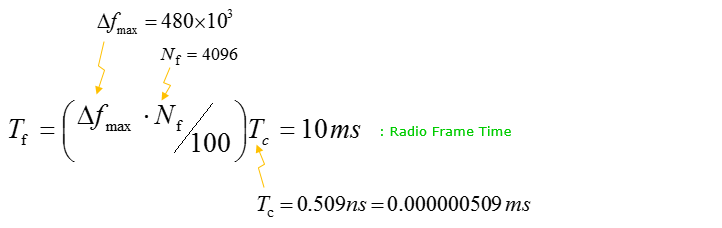
Tf stands for frame duration (the length of one radio frame) which is defined as follows. You would notice this is same as the radio frame duration of LTE.
Tsf stands for subframe duration (the length of one subframe) which is defined as follows. You would notice this is same as the subframe duration of LTE.
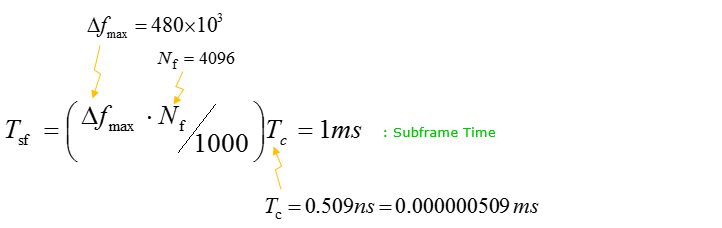
Both durations are multiples of Tc : neither the frame nor the subframe is defined directly in seconds.The divisor is the only difference : 100 gives the frame and 1000 gives the subframe, a factor of ten apart.The values are the LTE ones : 10 ms for a frame and 1 ms for a subframe are unchanged.The variation is in the slot count : the frame and the subframe stay fixed, and the number of slots per subframe is what the numerology changes.
Reference
[1] 38.211 v19.4.0 : NR - Physical channels and modulation. Clause 4.1 defines the basic time unit for NR, and clause 4.3.1 defines frames and subframes.