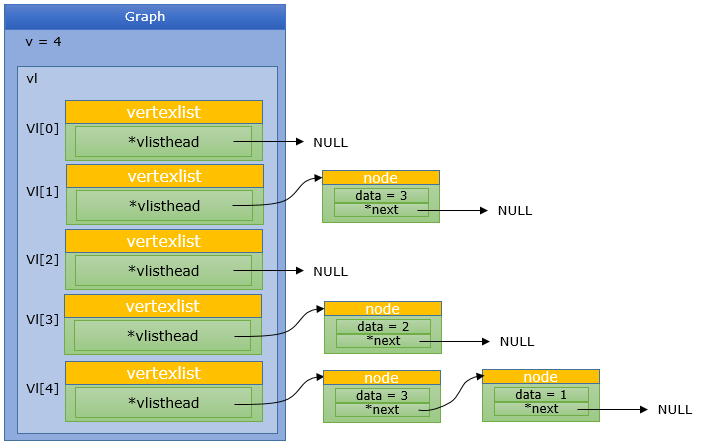
Graph Construction
This is sample code that is to implement the graph explained in Algorithm : Graph Construction. Refer to the page to understand the concept,
#include <malloc.h>
#include <stdio.h>
// A structure to represent a node in the adjacency list.
typedef struct NODE
{
int data;
struct NODE *next;
} node;
// A structure to represent list of vertexes(Node)
typedef struct VERTEXLIST
{
node *vlisthead;
} vertexlist;
// A structure to store the graph vertexes. This will store an Array
// and each element of the array will point to the head of a linked list
typedef struct GRAPH
{
int v;
vertexlist *vl;
} Graph;
// A function to declare the graph. This will create an array that will store the head of each
// linked list. Each of the linked list will store the nodes that are connected to a specific node
Graph* CreateGraph(int n)
{
int i;
Graph *vlist;
vlist = (Graph*) malloc(sizeof(Graph));
// store the number of nodes given by the user
vlist->v = n;
// allocate a block of memory location for the array that will store the head
// for each of the linked list
vlist->vl = (vertexlist*) malloc(sizeof(vertexlist)*(n+1));
// Initialize the head to NULL.
for(i = 0; i < n+1; i++)
{
vlist->vl[i].vlisthead = NULL;
}
return vlist;
}
// A function to add the edge into the graph.
// This will add the node at the beginning of the linked list for the node v1.
void AddNode(Graph *G, int v1, int v2)
{
node *newnode1;
node *newnode2;
node *temp;
newnode1 = (node*) malloc(sizeof(node));
newnode1->data = v1;
newnode1->next = NULL;
newnode2 = (node*) malloc(sizeof(node));
newnode2->data = v2;
newnode2->next = NULL;
// Connection v1 to v2.
if(G->vl[v1].vlisthead == NULL)
{
// If the head is null, insert the newnode2(v2) to the head of the linked list
// that stores all the nodes that are connected to the node v1.
G->vl[v1].vlisthead = newnode2;
}
else
{
// Otherwise, add the node at the beginning of the linkedlist.
newnode2->next = G->vl[v1].vlisthead;
G->vl[v1].vlisthead = newnode2;
}
}
int main()
{
int i, v = 4;
Graph *G = CreateGraph(v);
AddNode(G, 1, 3);
AddNode(G, 3, 2);
AddNode(G, 4, 1);
AddNode(G, 4, 3);
printf("\n\nLinkedList representaion of the Incidence Matrix for a graph: ");
for(i = 0; i < v; i++)
{
printf("\n\tV(%d) -> {",i+1);
while(G->vl[i+1].vlisthead != NULL)
{
printf(" %d",G->vl[i+1].vlisthead->data);
G->vl[i+1].vlisthead = G->vl[i+1].vlisthead->next;
}
printf(" }");
}
}
Result :------------------------------------------------------
LinkedList representaion of the Incidence Matrix for a graph:
V(1) -> { 3 }
V(2) -> { }
V(3) -> { 2 }
V(4) -> { 3 1 }
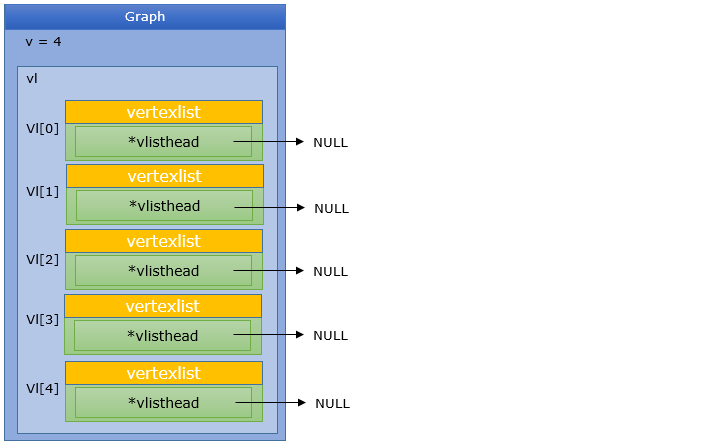
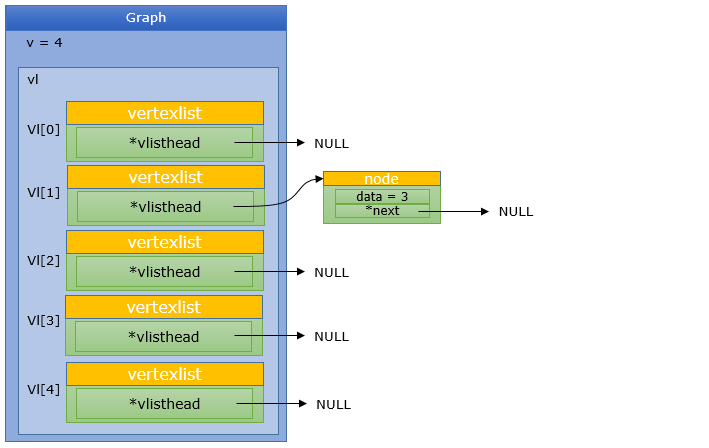
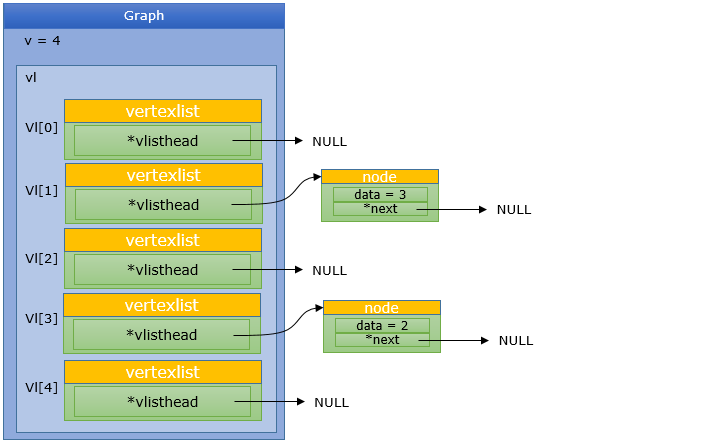
Now let me visualize what each of the code does.
Graph *G = CreateGraph(v);
AddNode(G, 1, 3);
AddNode(G, 3, 2);
AddNode(G, 4, 1);
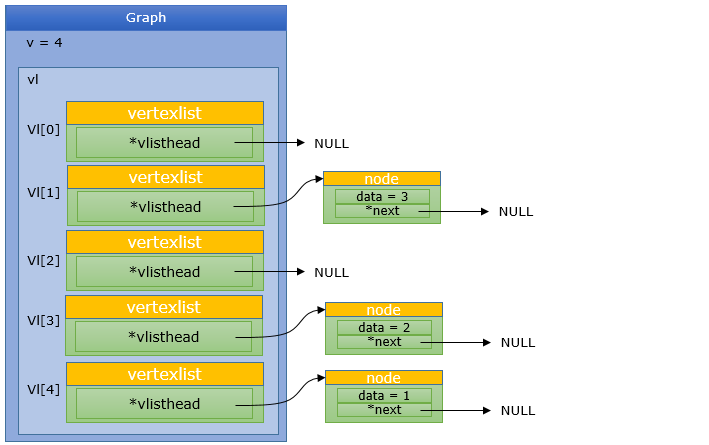
AddNode(G, 4, 3);